

























Heathrow Airport is not only the busiest airport in the United Kingdom but also its largest single-site employer.
With a workforce exceeding 90,000 individuals, the airport plays a crucial role in the national and regional economy.
But how are these jobs distributed? What kind of roles are available, and how has this employment evolved over time?
This comprehensive guide explores the employment landscape of Heathrow Airport, providing insight into how many people work there, what roles they perform, and the wider economic impact of this vital transportation hub.
What Is the Total Number of People Employed at Heathrow Airport?
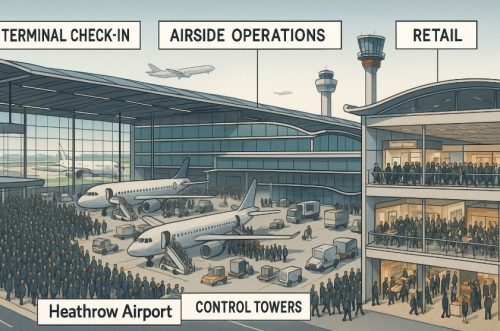
Heathrow Airport remains the largest single-site employer in the United Kingdom, with more than 90,000 people working across various roles on the airport campus.
These numbers include employees working directly for Heathrow Airport Limited, airline staff, external contractors, and those employed by third-party businesses operating within the airport’s terminals and facilities.
Employment numbers may differ depending on data sources, timeframes, and whether the figures reflect direct employees, on-site staff from third-party companies, or the broader economic influence.
For instance, in 2024, Heathrow Airport Holdings reported 8,286 employees within the core group, while other sources suggested between 75,000 and 80,000 people were directly involved in airport operations.
Another figure cited by Ferrovial in a 2025 press release indicates that over 76,500 people are employed on-site, and Heathrow’s own figures show that more than 66,000 individuals work across 400 different companies as part of what is referred to as “Team Heathrow”.
Employment Scope Comparison
| Type of Employment | Number of Employees | Source/Context |
| Total employment on Heathrow site | Over 90,000 | Includes all staff across airport operations, airlines, contractors, retail, etc. |
| Direct operations staff | 75,000 – 80,000 | Individuals working in core airport operations and services |
| Heathrow Airport Holdings | 8,286 | Directly employed by the holding company (2024 data) |
| Team Heathrow (partner companies) | More than 66,000 | Staff working for 400+ businesses operating at Heathrow |
| Press release figure (Ferrovial, 2025) | Over 76,500 | External reporting based on updated estimates |
These variations illustrate the difference in defining employment scope. Some figures refer only to the airport operator’s direct employees, while others account for all workers across the wider Heathrow campus.
What Are the Main Job Categories at Heathrow Airport?

Heathrow Airport is a vast operational ecosystem that functions like a city. It employs people in an extensive variety of roles, covering every aspect of aviation, logistics, customer service, security, administration, and commercial operations.
With more than 90,000 individuals working across the site, understanding the primary job categories helps illustrate the scale and complexity of what it takes to keep the airport functioning seamlessly, 24 hours a day.
Heathrow’s workforce is generally structured into five overarching categories: airside operations, passenger services, technical and engineering roles, commercial services, and support functions. Each category plays a critical role in delivering efficient, safe, and customer-centric airport operations.
Airside Operations
Airside jobs include roles that take place on the tarmac or within secured operational zones. These positions require specialised training and often involve strict regulatory compliance due to their proximity to aircraft and airside logistics.
Employees in this category are responsible for coordinating aircraft arrivals and departures, loading and unloading cargo and luggage, ensuring refuelling and aircraft safety checks, and directing planes on the runway.
Typical roles in this category include:
- Aircraft marshallers
- Ramp agents
- Airside safety inspectors
- Loadmasters
- Ground service technicians
This category also includes employees who manage gate-side coordination between airline crew and ground support, especially during boarding and disembarkation.
Passenger Services
Passenger service is one of the most visible and essential aspects of Heathrow’s operations. These roles are dedicated to providing travellers with a safe, smooth, and efficient journey through the airport.
Staff in this category often act as the face of the airport, interacting directly with thousands of passengers daily.
Customer service agents assist passengers at check-in counters, boarding gates, transfer desks, and immigration halls.
Additional roles in this category include lost property coordinators, special assistance providers for passengers with reduced mobility, and queue management officers.
Many of these positions require multilingual skills, conflict resolution abilities, and extensive knowledge of airline protocols and terminal layouts.
The goal of passenger service staff is to deliver a high-quality, stress-free experience from the moment travellers enter the terminal until they board their flights.
Security and Border Control
A significant portion of Heathrow’s workforce is employed in security roles. These staff members are responsible for maintaining safety across the airport by screening passengers, luggage, and cargo, monitoring surveillance systems, and coordinating with UK Border Force and other law enforcement agencies.
Security roles include:
- Security screening officers
- CCTV monitoring personnel
- Behavioural detection officers
- Access control administrators
- Explosive trace detection (ETD) specialists
Given the sensitive nature of airport security, individuals in these roles undergo rigorous background checks, regular re-training, and must stay updated on the latest international aviation security standards.
Technical, Engineering and Maintenance Roles
Heathrow is home to advanced infrastructure and technologies that require continual oversight by qualified professionals.
Engineering and technical teams ensure that all mechanical, electrical, and digital systems function correctly.
From baggage handling systems and HVAC units to automated walkways and terminal lighting, technical staff keep essential systems running smoothly.
Mechanical engineers, civil engineers, systems analysts, and electrical technicians work around the clock to prevent service disruptions.
These roles often require formal qualifications and experience in industrial or aviation-focused environments.
Maintenance roles also include facilities managers and building services engineers who are responsible for terminal maintenance and repairs.
With Heathrow’s increasing adoption of smart technologies, roles in IT support, cybersecurity, systems integration, and data management are also expanding rapidly.
Retail and Commercial Services
Beyond its aviation-related operations, Heathrow is a major retail destination. The terminals host a vast number of shops, restaurants, cafés, and luxury brand outlets. These establishments employ thousands of staff in customer-facing and back-of-house roles.
Retail sales assistants help customers with purchases in duty-free shops and boutiques, while hospitality staff operate restaurants, coffee shops, and lounges.
These roles contribute not only to customer satisfaction but also to Heathrow’s commercial revenue.
Many of these jobs are offered by third-party companies leasing retail space within the airport, though they are part of the broader Heathrow workforce.
In this environment, staff must maintain high standards of service while working in a fast-paced, diverse setting. Opportunities for progression are common, especially in supervisory or brand-specific management roles.
Administrative and Strategic Roles
Behind the scenes, Heathrow is supported by a vast range of administrative professionals and strategic departments that manage everything from human resources and finance to planning, public relations, and legal compliance.
Administrative staff are essential for coordinating hiring processes, ensuring regulatory standards are met, tracking financial performance, and implementing operational strategy. These departments typically include:
- Human resources officers
- Legal and compliance analysts
- Finance and accounting specialists
- Procurement managers
- Planning and operations analysts
These positions often require specialised qualifications and play a major role in shaping the airport’s long-term success and sustainability initiatives.
How Do Airline and Ground Handling Staff Contribute to Heathrow Operations?
Airlines operating from Heathrow account for a large percentage of the total workforce. Each terminal houses multiple carriers that rely on both in-house and contracted staff to manage day-to-day airline functions.
Ground handling services are especially critical in this category. These staff members are responsible for ensuring aircraft are cleaned, loaded, fuelled, and ready for departure within scheduled timeframes.
They are also in charge of transferring luggage, managing cargo logistics, and supporting crew operations.
The contribution of ground and airline personnel extends beyond simple logistics. These teams play an essential role in maintaining Heathrow’s efficiency, particularly during peak travel seasons.
While airline staff like cabin crew and pilots may not be permanently based at Heathrow, their presence adds to the overall headcount on any given day.
Which Support Roles Are Essential to Heathrow’s Daily Functioning?

In addition to passenger and aircraft-facing staff, Heathrow relies on a wide array of support personnel who work behind the scenes. These positions may not be immediately visible to passengers but are vital to the airport’s functionality.
Human resources and recruitment teams are responsible for sourcing, hiring, and training staff across various departments.
IT specialists manage everything from cybersecurity to passenger information systems, while administrative staff ensure compliance with both regulatory and internal operational standards.
Cleaning, sanitation, and facilities management teams maintain the terminals, ensuring a hygienic and well-organised environment.
These roles have grown in importance post-pandemic, with more stringent cleanliness protocols in place.
Additional roles are found in planning, legal, procurement, and environmental management departments.
Heathrow’s growing sustainability initiatives, particularly around emissions reduction and energy efficiency, have created demand for experts in green technologies and environmental compliance.
What Role Do Retail and Hospitality Jobs Play at Heathrow?
Retail and hospitality contribute significantly to Heathrow’s total employment figures. The airport is home to a large number of outlets ranging from global high street brands to luxury retailers. These include duty-free stores, electronics shops, designer boutiques, and convenience stores.
Hospitality services, including restaurants, coffee shops, bars, and food courts, employ thousands of people across the four active terminals.
From front-of-house staff to chefs, kitchen assistants, and logistics coordinators, these jobs keep passengers fed and refreshed during their journeys.
These retail and hospitality operations are usually managed by third-party businesses, although Heathrow Airport Limited plays a role in the coordination and leasing of retail space.
Retail jobs at Heathrow are often seen as attractive because they combine customer-facing service with the opportunity to work in a fast-paced, international environment.
Some positions also offer flexibility in shifts, multilingual interaction, and career progression through training and promotion schemes.
How Has Heathrow Airport Expansion Impacted Job Creation?
The proposed expansion of Heathrow, including the development of a third runway, has been central to discussions around job creation in recent years.
Though subject to delays and political scrutiny, the project has outlined potential economic benefits for the UK, especially in terms of employment.
During the construction phase, thousands of temporary jobs are expected to be created. These include engineering, architecture, project management, and manual labour roles.
Once the expansion is completed, long-term roles are anticipated in airport operations, airline services, logistics, and retail.
Several reports have suggested that the full implementation of the expansion could support up to 180,000 new jobs nationwide, although this includes indirect employment stimulated by increased airport capacity and improved trade connectivity.
The project also involves upgrading transport links, building new infrastructure, and improving terminal capacity.
Each of these elements has the potential to create ongoing job opportunities not only within the airport but also in supporting sectors such as construction, supply chain, and regional commerce.
What Career Opportunities Are Available for Job Seekers at Heathrow?

Heathrow offers employment across all levels of experience, from entry-level positions to highly specialised technical and executive roles. The airport maintains a dedicated careers portal where job seekers can search for open positions by department or skill level.
The Heathrow Academy plays a major role in preparing local residents for airport employment.
The academy offers training in customer service, logistics, and hospitality, helping applicants develop the skills required for permanent positions.
Apprenticeship schemes are available in areas such as engineering, IT, security, and operations.
Many of these apprenticeships are run in collaboration with educational institutions and offer hands-on learning along with formal qualifications.
Some of the most common entry points for new applicants include:
- Security personnel
- Retail sales assistants
- Passenger service agents
- Cleaners and janitors
- Customer service assistants
For experienced professionals, opportunities exist in engineering, airport planning, legal compliance, environmental management, and executive leadership roles.
How Does Heathrow Compare to Other UK Airports in Employment?
Heathrow employs significantly more people than any other UK airport. The employment gap between Heathrow and its closest peers underlines its importance not just in the aviation sector but also in the broader UK economy.
Comparison of UK Airport Employment Figures
| Airport | Approximate Employment |
| Heathrow | Over 90,000 |
| Gatwick | Around 24,000 |
| Manchester | Around 20,000 |
| Stansted | Around 12,000 |
| Birmingham | Around 7,000 |
This disparity is largely due to Heathrow’s scale, international connectivity, and role as a major hub for global travel.
Its four terminals, combined with freight, maintenance, and business services, require a far larger workforce than regional airports.
How Has Technology Changed Jobs at Heathrow Over Time?

Heathrow has seen significant transformation in the types of jobs available due to advances in technology.
Automation and digitisation have changed how various departments function, affecting both the skillsets required and the number of people needed for certain tasks.
Automated check-in kiosks and eGates have streamlined passenger processing, reducing the need for large numbers of check-in agents.
Baggage handling systems now rely on advanced tracking and conveyor networks, minimising manual labour and increasing efficiency.
Air traffic control has also become more data-driven, with software assisting in flight path planning, weather forecasting, and real-time aircraft positioning.
Technology has not eliminated jobs but instead shifted the focus. There is a growing demand for:
- IT support and systems analysts
- Cybersecurity experts
- Data scientists and operations researchers
- Engineers specialising in automation systems
- Technical trainers and digital process managers
These roles help ensure that Heathrow remains one of the world’s most technologically advanced and efficient airports.
Frequently Asked Questions
How accurate are Heathrow’s employment figures?
Employment figures can vary depending on the data source and whether they include direct, indirect, or associated jobs.
What is “Team Heathrow”?
Team Heathrow refers to the network of over 400 companies operating within Heathrow that employ more than 66,000 people collectively.
Are most Heathrow employees hired directly by the airport?
No. While Heathrow Airport Limited employs around 8,000–10,000 people, the majority work for partner companies and retailers.
What types of jobs are most in demand at Heathrow?
Roles in security, baggage handling, customer service, and hospitality are consistently in high demand.
Does Heathrow offer remote or hybrid working options?
Most roles are on-site due to the operational nature of the airport, but some administrative and technical roles may offer hybrid options.
Are there entry-level opportunities for school leavers?
Yes, through apprenticeships, internships, and Heathrow Academy training programmes aimed at young people.
Is Heathrow still hiring during economic downturns or global crises?
Hiring may slow, but critical roles in security, maintenance, and operations often remain open to ensure uninterrupted airport function.