

























Every investor eventually faces a market correction. The term might sound dramatic, but corrections are a natural part of investing.
They serve as a reset for overheated valuations, test investor confidence, and often create long-term buying opportunities.
In 2025, market volatility has returned to headlines, and many investors are asking the same question: Is this a normal correction, or is something fundamentally different this time?
This guide breaks down what a market correction is, how 2025 compares to past periods, and what smart investors are watching to navigate uncertainty without losing focus.
What Is a Market Correction?
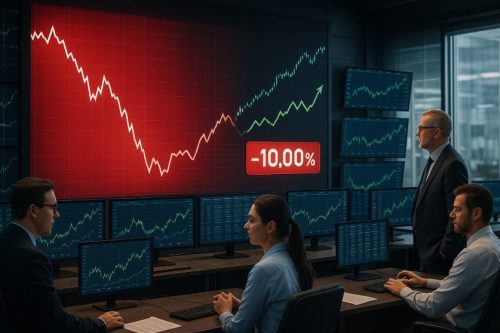
What is a stock market correction? It’s when a major stock index such as the S&P 500, Nasdaq, or Dow Jones falls by 10% or more from its recent peak. Corrections are a normal part of market cycles and typically occur every one to two years.
They are different from bear markets, which involve a deeper decline of 20% or more. Corrections are usually shorter and less severe, often lasting a few weeks to a few months, though full recoveries can sometimes take longer.
For many investors, corrections serve as a reset, creating opportunities to buy quality assets at lower prices.
Why Corrections Happen?
- Profit-taking after long bull runs
- Rising interest rates or inflation
- Disappointing earnings or economic data
- Geopolitical uncertainty
- Shifts in investor sentiment or risk appetite
While uncomfortable, corrections are a normal part of market cycles. They give valuations time to cool, highlight weak business models, and help remove excessive speculation.
What’s Considered Normal?: Historical Context
To know whether a current dip is unusual, it’s important to understand how past corrections played out.
- The S&P 500 has averaged a 14% intra-year decline since 1980, even in years that finished positive overall.
- On average, markets see one correction per year.
- Most corrections recover within three to six months.
- Corrections often happen without a recession. For example, in 2018 and early 2022, the market corrected even while economic growth remained positive.
Typical Signs of a Normal Correction
- Broad-based selling, not just in one sector
- Economic fundamentals remain stable
- Central banks are not actively hiking aggressively or withdrawing liquidity all at once
- No major credit crisis or systemic risk event
In these conditions, market pullbacks are often technical, sentiment-driven, or related to rotation between sectors not signs of collapse.
What’s Different in 2025?
While market corrections are not new, the context in 2025 includes several unique dynamics that investors need to pay attention to.
1. Artificial Intelligence Has Changed Market Leadership
In 2023 and 2024, a handful of mega-cap tech companies driven by AI development accounted for the bulk of stock market gains. In early 2025, those same companies are facing increased scrutiny over valuation, earnings consistency, and competitive threats.
A correction in 2025 may feel more intense because of this concentration. When the largest companies start to fall, they drag down the index faster.
2. Interest Rates Remain Elevated
Central banks have paused rate hikes, but they have not returned to the ultra-low interest rates of the past decade.
The Federal Reserve’s benchmark rate remains near 5.25 %, and the European Central Bank is also holding steady.
This affects:
- Growth stock valuations, especially tech
- Credit availability for companies and consumers
- Earnings expectations as costs of capital rise
Unlike prior corrections when rates were cut quickly, central banks in 2025 are more cautious. This limits the immediate support markets typically expect.
What to Watch During a 2025 Correction?
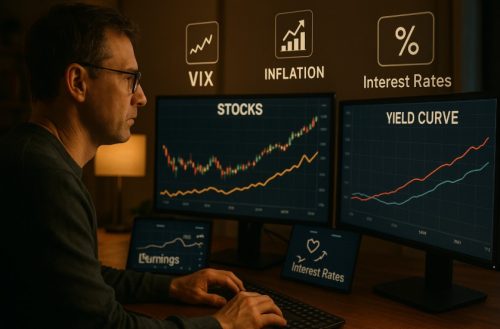
To separate signals from noise, here are key indicators that can help investors understand what is happening beneath the surface.
Market Breadth
Are only a few stocks falling, or is the decline broad-based? When most sectors fall together, it suggests a macro issue. If only tech or energy is struggling, it may be sector rotation.
Volatility Index (VIX)
The VIX, often called the fear gauge, tends to spike during uncertainty. Readings above 25 suggest elevated investor anxiety. Extremely high levels, like 40 or more, can mark capitulation phases.
Yield Curve
Watch the difference between short-term and long-term bond yields. A steepening curve may signal improving confidence, while an inverted curve may suggest recession concerns.
Corporate Earnings
Are companies missing targets, or is guidance being revised downward? Strong earnings often stabilize markets, even during corrections.
Central Bank Commentary
Look for signs that central banks are acknowledging risks. In past corrections, verbal support or small policy shifts have helped stabilize sentiment.
How Investors Should Respond?
Market corrections feel uncomfortable, but the worst mistake is reacting emotionally. Smart investors use corrections to review strategies, not abandon them.
Stay Invested with Discipline
Trying to time the bottom often leads to missed recoveries. Historically, the biggest up days often follow sharp drops. Missing just a few of those days can reduce long-term returns significantly.
Rebalance with Intent
A correction may create an opportunity to:
- Buy into quality sectors at lower prices
- Reduce overexposed positions
- Realign with long-term asset allocation targets
If your risk tolerance remains the same, your portfolio should reflect your plan not the headlines.
Focus on Fundamentals
Not all companies are impacted equally. Use this time to evaluate earnings quality, cash flow strength, and sector resilience. Strong businesses often emerge stronger from corrections.
Consider Dollar-Cost Averaging
If you’re building a position, buying in regular intervals spreads your entry price and reduces the impact of short-term swings.
During the 2022 correction, investors who consistently added to low-cost index funds like VTI or global ETFs saw gains within 12 to 18 months as markets recovered.
What Corrections Teach Long-Term Investors?
Corrections are not a failure of the system they are part of the process. They reinforce valuable lessons:
- Volatility is normal, not a signal to panic
- Discipline often outperforms emotion
- Markets reward long-term participation over short-term reaction
- Diversification helps soften the blow when specific sectors or regions falter
Every correction looks different, but the principles that guide smart investing remain the same.
Final Thoughts
In 2025, corrections are once again challenging investor confidence. But history shows that most market declines of 10 to 15 % are followed by recoveries that reward those who stayed the course.
What’s different in 2025 is the level of concentration, the lingering effects of elevated interest rates, and the multi-region nature of global risk.
What remains the same is the market’s tendency to move in cycles, and its long-term upward trend for those who invest with patience and clarity.
Corrections create opportunities. Not just to buy at better prices, but to refine your approach, reassess your goals, and reinforce the habits that build long-term wealth.