


























You can have as many stocks and shares ISAs as you want in the UK, and you can contribute to more than one during the same tax year.
However, the total amount you invest across your adult ISAs must remain within the annual £20,000 allowance for 2026/27.
This flexibility has been available since 6 April 2024, when HMRC removed the previous restriction on paying into only one stocks and shares ISA per tax year.
For example, you could invest £8,000 through one provider, £7,000 through another and £5,000 through a third. All three contributions are permitted because the combined investment is £20,000.
The important distinction is between how many accounts you can hold and how much new money you can contribute.
Although multiple stocks and shares ISAs can give you access to different investment platforms, funds and fee structures, opening additional accounts does not increase your personal tax-free allowance.
Can I Have Two Stocks and Shares ISAs in the Same Tax Year?
Yes. UK investors can open and contribute to two or more stocks and shares ISAs in the same tax year, provided they meet the eligibility conditions and stay within their combined annual allowance.
Before 6 April 2024, investors were generally restricted to contributing to one stocks and shares ISA in each tax year. They could retain accounts from previous years but could not normally fund multiple accounts of the same type simultaneously.
That restriction no longer applies to ordinary stocks and shares ISAs.
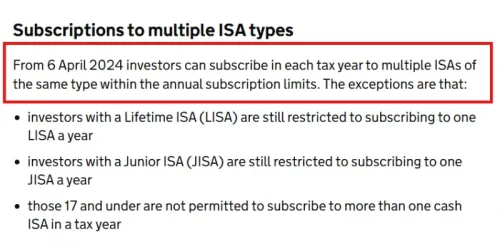 HMRC confirms that UK investors can contribute to multiple stocks and shares ISAs in the same tax year from 6 April 2024.
Under the current HMRC rules on subscribing to multiple ISAs, investors can subscribe to multiple ordinary ISAs of the same type during a tax year.
This means you can:
- Open two or more stocks and shares ISAs with different investment providers.
- Contribute new money to multiple investment ISAs during the year.
- Keep stocks and shares ISAs opened in previous tax years.
- Hold cash ISAs and investment ISAs alongside each other.
- Move existing ISA investments between providers through an official ISA transfer.
However, individual investment platforms may have their own restrictions on opening multiple accounts with the same provider.
Example: Investing Across Three Stocks and Shares ISAs
Suppose an investor wants to use three different platforms during the 2026/27 tax year.
| ISA provider | Annual contribution |
| Provider A | £8,000 |
| Provider B | £7,000 |
| Provider C | £5,000 |
| Total | £20,000 |
This arrangement is permitted because the total contributions do not exceed the annual allowance.
The investor could hold different funds or individual shares through each provider, but they would have no remaining ISA contribution allowance for that tax year.
How Many Stocks and Shares ISAs Can I Have Across Different Tax Years?
There is no fixed statutory limit on the number of ordinary stocks and shares ISAs you can hold across different tax years.
Someone who opened an investment ISA in 2021 could retain that account while opening additional accounts in 2024, 2025 and 2026.
The money already invested in previous tax years can remain inside the ISA wrapper and continue benefiting from the relevant tax exemptions.
For example, an investor might have:
| Tax year | Investment ISA contributions |
| 2022/23 | £10,000 |
| 2023/24 | £12,000 |
| 2024/25 | £18,000 |
| 2025/26 | £20,000 |
| 2026/27 | £20,000 |
| Total contributed | £80,000 |
The investor could have £80,000 in original contributions across their accounts, plus any investment growth or minus any investment losses, without breaching the annual subscription rules.
The £20,000 restriction applies to new contributions during each tax year, not the total market value of accumulated investments.
This is why understanding whether you can put £20,000 into an ISA every year is important when planning long-term investments.
What Is the Stocks and Shares ISA Allowance for 2026/27?
The annual adult ISA allowance for the 2026/27 tax year is £20,000.
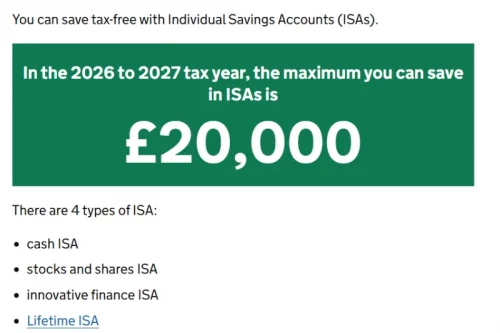
The official UK government ISA allowance remains £20,000 for the 2026/27 tax year.
The current tax year runs from 6 April 2026 to 5 April 2027.
This allowance can be divided between different eligible ISA types, including stocks and shares ISAs, cash ISAs, innovative finance ISAs and Lifetime ISAs.
You cannot contribute £20,000 separately to each type because the allowance is shared.
For example:
| ISA type | Contribution |
| Stocks and shares ISA 1 | £6,000 |
| Stocks and shares ISA 2 | £5,000 |
| Cash ISA | £5,000 |
| Lifetime ISA | £4,000 |
| Total | £20,000 |
In this example, the investor has fully used the annual ISA allowance.
A Lifetime ISA has its own £4,000 annual contribution limit, which forms part of the overall £20,000 allowance. Investors can generally contribute to only one Lifetime ISA during a tax year.
If the annual allowance is not fully used by 5 April 2027, the unused portion cannot normally be carried forward.
For instance, contributing only £12,000 in 2026/27 does not mean you can invest £28,000 in 2027/28. The unused £8,000 expires when the tax year ends.
When Should You Consider a Stocks and Shares ISA?
A stocks and shares ISA is generally worth considering when you want to invest for long-term financial objectives and are comfortable with fluctuations in investment value.
Unlike an ordinary savings account, the money placed inside an investment ISA can be used to purchase financial assets that may rise or fall in value.
An investment ISA may suit someone who:
- Plans to invest for at least five years, preferably longer.
- Does not need immediate access to the invested money.
- Wants exposure to shares, bonds or investment funds.
- Can tolerate periods of declining market value.
- Wants to build investments without paying UK capital gains tax or income tax on eligible returns within the ISA.
- Has sufficient accessible savings for emergencies.
However, there is no guaranteed minimum return.
A person saving for a short-term expense, such as a house deposit needed next year, may find that market volatility creates unacceptable risk.
Someone beginning their investment journey should understand how to invest money and assess investment risk before choosing individual shares or funds.
The ability to use multiple ISAs can improve investment flexibility, but it does not necessarily make a portfolio more suitable for every investor.
What Investments Can You Hold in a Stocks and Shares ISA?
A stocks and shares ISA is a tax-efficient investment account rather than a single financial product.
Different providers offer access to different eligible investments.
Common investments include:
Individual company shares: Investors can purchase shares in eligible listed companies. Returns depend on movements in share prices and any dividends paid.
Exchange-traded funds (ETFs): These funds can provide exposure to multiple companies, sectors, bonds or markets through a single investment.
Investment trusts: These are investment companies that pool investors’ money and invest according to a defined strategy.
Unit trusts and OEICs: These collective investment funds allow investors to gain exposure to a managed portfolio of eligible assets.
Government bonds: These are debt securities issued by governments, including UK gilts. Their market value can fluctuate, particularly when interest rates change.
Corporate bonds: These represent loans to companies and may provide interest payments, although repayment and market-value risks remain.
Long-Term Asset Funds: Eligible Long-Term Asset Funds have been permitted within stocks and shares ISAs since April 2026, broadening access to certain longer-term and less liquid investments.
Not every provider makes every eligible investment available.
Some platforms focus on ready-made portfolios, while others offer extensive selections of funds, ETFs, individual shares and bonds.
Investors should therefore compare the available assets before deciding where to open an ISA.
How Do Stocks and Shares ISAs Work?
A stocks and shares ISA acts as a tax-efficient wrapper around qualifying investments.
You open an account with an investment platform, add money and select the investments you want to hold, or choose a ready-made portfolio if the provider offers one.
Once invested, the value of the account changes according to the performance of its underlying assets.
There are several important features.
1. Tax-Free Investment Growth
Under current UK ISA rules, capital gains arising from investments held within a qualifying ISA are exempt from UK capital gains tax.
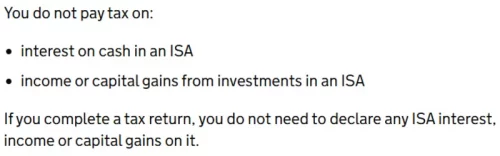
GOV.UK confirms the tax exemptions applying to qualifying income and capital gains from investments held inside ISAs.
Eligible dividends and investment income received within the ISA are also exempt from UK income tax.
This protection applies regardless of whether an investor maintains one ISA or several accounts.
An ISA does not necessarily eliminate foreign withholding taxes applied to overseas investment income.
2. Lump-Sum or Regular Investing
Investors can contribute money through a single payment or by making regular deposits during the tax year.
For example, monthly contributions of £500 would total £6,000 over 12 months.
Regular investing can spread investment purchases across different market conditions, although it does not guarantee a profit or prevent losses.
3. Investments Can Remain Tax-Protected for Years
An existing ISA does not automatically close when the tax year ends.
Provided the account continues to meet the applicable rules, investments can remain inside the wrapper.
You do not have to sell all your investments or reopen your ISA every April.
4. The ISA Allowance Resets Annually
A new annual allowance becomes available when the next tax year begins on 6 April.
However, any allowance left unused during the previous year is normally lost.
5. Investment Returns Are Not Guaranteed
Unlike an ordinary cash savings account paying a specified interest rate, a stocks and shares ISA does not provide a guaranteed investment return.
Performance depends on the assets held, prevailing market conditions, investment charges and the decisions made by the investor or fund manager.
What Are the Four Main Types of ISA?
The UK currently has four main categories of adult ISA.
| ISA type | Main purpose | Key feature |
| Cash ISA | Tax-free cash savings | Can pay interest without investment market exposure |
| Stocks and shares ISA | Investing in financial assets | Investment gains and qualifying income are tax-exempt |
| Lifetime ISA | First-home purchase or later-life savings | Government bonus on qualifying contributions |
| Innovative finance ISA | Eligible alternative lending and investments | Potential returns with specific investment and liquidity risks |
Cash ISA
A cash ISA works similarly to an ordinary savings account, but interest is free from UK income tax.
Interest rates and access conditions vary between providers.
Some cash ISAs offer variable rates, while fixed-rate products may restrict access or impose penalties for early withdrawals.
Lifetime ISA
A Lifetime ISA is designed to support eligible first-time homebuyers and people saving for later life.
You must normally be between 18 and 39 to open one, and you can contribute until your 50th birthday.
The government provides a 25% bonus on eligible contributions, up to a standard maximum of £1,000 per year.
For example, contributing £4,000 could generate a £1,000 government bonus.
The bonus does not necessarily appear immediately after a deposit. Processing times depend on the provider’s HMRC claims and allocation process, which is why when the government bonus is paid on a LISA matters for financial planning.
Withdrawals outside qualifying circumstances usually attract a 25% withdrawal charge.
Stocks and Shares ISA
A stocks and shares ISA allows investors to hold qualifying investments within a tax-efficient account.
Its performance depends on investment returns rather than a fixed savings interest rate.
Innovative Finance ISA
An innovative finance ISA can hold eligible investments such as certain peer-to-peer lending arrangements and crowdfunding debt securities.
These investments can involve borrower default, liquidity and platform-related risks.
They should not be regarded as equivalent to protected bank deposits.
Investors who want to understand the restrictions on holding multiple ISA types can also examine how different ISA accounts work together.
Can I Have a Cash ISA and Two Stocks and Shares ISAs?
Yes. You can hold a cash ISA alongside two or more stocks and shares ISAs.
Since the April 2024 reforms, you can also contribute to multiple eligible ordinary ISAs of the same type within the same tax year.
For example, an investor could contribute:
- £10,000 to a stocks and shares ISA containing diversified funds.
- £5,000 to another stocks and shares ISA containing individual shares.
- £5,000 to a cash ISA earning interest.
The total is £20,000, which is within the 2026/27 annual limit.
Holding a cash ISA and stocks and shares ISAs with the same financial institution is also possible where the provider offers both account types.
There is no general HMRC rule requiring you to choose a different provider for each type.
However, individual providers decide which accounts they offer and whether customers can open multiple accounts within their systems.
How to Choose the Best Stocks and Shares ISA Provider?
When selecting a stocks and shares ISA, the cheapest-looking platform is not automatically the most suitable.
The best choice depends on investment needs, trading frequency, portfolio value and the level of support required.
Important factors include:
Platform and Management Fees
ISA providers may charge an annual platform fee, a percentage of the portfolio’s value or a fixed subscription.
Managed portfolios can involve additional management costs.
Investment funds may also have their own ongoing charges.
A provider charging 0.25% annually on a £20,000 portfolio would charge £50 for that platform fee alone, assuming the portfolio value remains constant. Other costs may apply.
Investment Selection
Some platforms offer thousands of investments, while others provide a limited range of ready-made portfolios.
A beginner seeking a diversified fund may not need the same functionality as an experienced investor trading individual securities.
Trading and Foreign Exchange Charges
Share-dealing commissions and foreign exchange fees can affect returns.
Investors buying overseas shares should compare currency-conversion costs as well as the headline trading fee.
Transfer and Closure Fees
Before opening an ISA, check whether the provider charges for transferring assets away or closing the account.
The receiving provider should also confirm whether it accepts transfers of existing investments.
Customer Support and Security
Compare customer service availability, account security, regulatory status and the information provided about investments and charges.
An investment platform should also make it straightforward to review holdings, monitor costs and access account statements.
What Are the Risks of Having Multiple Stocks and Shares ISAs?
Although multiple ISAs offer flexibility, the arrangement has potential disadvantages.
Market risk: Investments can decline in value, and it is possible to receive less than the original amount invested.
Duplicated investments: Two separate ISAs may contain similar funds holding many of the same companies. Opening more accounts does not automatically create greater diversification.
Higher costs: Separate platforms can result in additional subscription, management, dealing or transfer fees.
Administrative complexity: Monitoring several accounts requires tracking investments, contribution limits and provider communications.
Liquidity risk: Certain investments may not be easily sold, particularly during periods of market disruption.
Fraud and platform risk: Investors should confirm the regulatory status of an investment provider and understand the protections applying to their assets.
Sarah Pritchard, Deputy Chief Executive of the Financial Conduct Authority, highlighted the importance of investment decisions reflecting consumers’ individual circumstances in her November 2025 address to The Investing and Saving Alliance.
She emphasised the need for consumers to receive a fair impression of investment risks rather than relying on simplified warnings.
Her observations reinforce an important point: investors should judge a stocks and shares ISA by the assets it contains, the risks involved and their own financial circumstances, not simply by the potential returns advertised.
The Financial Services Compensation Scheme may provide protection in certain circumstances involving failed authorised firms, but it does not normally compensate investors for ordinary market losses.
Can You Transfer Money Between Stocks and Shares ISAs?
Yes. Existing ISA funds can generally be transferred between providers without counting as new contributions towards the annual ISA allowance.
This can be useful for investors who want to consolidate accounts, reduce costs or access different investments.
To make an ISA transfer, contact the provider receiving the money and complete its official transfer process.
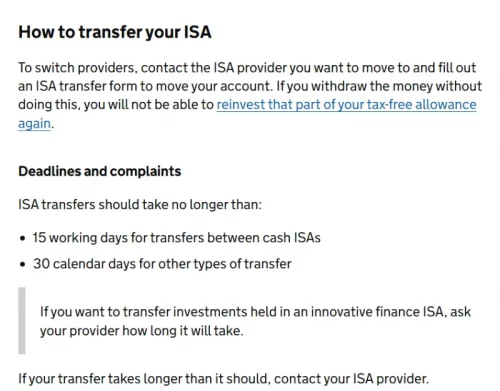
GOV.UK explains how to transfer an ISA between providers while preserving its tax-free status.
You should not simply withdraw money into your ordinary bank account and then deposit it with another ISA provider.
That could result in the new deposit being treated as a fresh contribution and could affect the tax-efficient status of the money.
Can I Transfer Part of My Stocks and Shares ISA?
Under the current rules, investors can generally transfer all or part of their ISA holdings, including current-year and previous-year money, where the relevant providers support the transaction.
Some providers accept investments directly through an in-specie transfer, while others may require investments to be sold and transferred as cash.
Selling investments for a transfer can mean being out of the market while the process takes place.
HMRC indicates that transfers involving stocks and shares ISAs should normally be completed within 30 calendar days.
If a transfer takes longer, contact the provider to check its progress.
How Do You Generate Returns From a Stocks and Shares ISA?
Investment returns generally come from two sources: capital growth and investment income.
Capital Growth
Capital growth occurs when an investment increases in market value.
For example, an investment purchased for £5,000 that later becomes worth £6,000 has an unrealised gain of £1,000.
That represents a 20% increase before considering any applicable costs.
However, if the value falls to £4,000, the investment has experienced a 20% loss.
Dividends and Other Investment Income
Some companies distribute part of their profits to shareholders as dividends.
Certain funds distribute income received from underlying investments, while bonds can generate interest payments.
Where these returns qualify for the ISA exemption, they are not subject to UK income tax within the account.
Investors may choose to reinvest income, potentially benefiting from compound growth over time.
In July 2025, Emma Reynolds, then Economic Secretary to the Treasury, stated in an official HM Treasury announcement:
“Helping people take advantage of better returns from investing is key to better financial health.”
Her statement formed part of the government’s wider efforts to encourage informed participation in financial markets.
However, potentially higher long-term returns are not guaranteed. Investors must still consider volatility, diversification, investment costs and the possibility of losing capital.
Stocks and Shares ISA vs Cash ISA: Which Is Better?
The main difference between a cash ISA and a stocks and shares ISA is the type of return and risk involved.
| Feature | Cash ISA | Stocks and shares ISA |
| Primary use | Saving money | Investing money |
| Returns | Interest | Investment growth and income |
| Market risk | No direct investment market exposure | Value can rise or fall |
| Access | Depends on savings product | Depends on platform and investment liquidity |
| Tax benefits | Tax-free interest | Tax-free qualifying investment income and gains |
| Suitable time horizon | Often short or medium term | Generally longer term |
| Return certainty | Rate may be fixed or variable | No guaranteed return |
A cash ISA may be more suitable for money required in the near future.
A stocks and shares ISA may be appropriate for longer-term investing when the investor accepts market risk.
Some people choose both to separate accessible savings from long-term investments.
What Will Change for Stocks and Shares ISAs in April 2027?
The government has introduced ISA reforms scheduled to take effect from 6 April 2027.
For the 2026/27 tax year, the overall ISA contribution allowance remains £20,000.
From April 2027, the annual cash ISA subscription limit for people below the applicable age exemption will fall to £12,000.
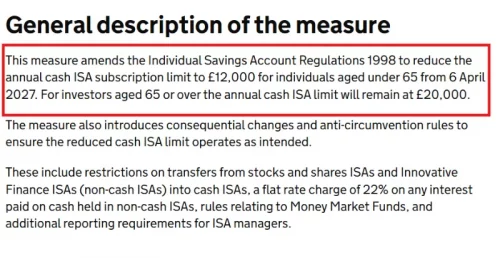
HMRC confirms the reduction in the annual cash ISA subscription limit to £12,000 for eligible savers under 65 from April 2027.
The overall adult ISA allowance will remain £20,000, meaning the remaining allowance can be used for other eligible ISA types.
People aged 65 or over under the applicable tax-year rules will retain the £20,000 cash ISA allowance.
The HMRC policy on the cash ISA limit reduction also explains restrictions affecting transfers from non-cash ISAs into cash ISAs.
For investors below the age exemption, transfers from stocks and shares ISAs into cash ISAs will be restricted from April 2027.
Further changes include a 22% charge on interest paid on cash held within non-cash ISAs and measures affecting money market funds.
These reforms are important for anyone planning to hold substantial cash balances or move investments between ISA types.
They do not remove the ability to hold multiple stocks and shares ISAs, and the overall £20,000 ISA allowance will remain in place.
Is It Better to Have One Stocks and Shares ISA or Multiple Accounts?
There is no universal answer.
One account may be more convenient because it consolidates investments, simplifies monitoring and reduces the need to manage different platforms.
Multiple accounts may provide access to investment products unavailable through one provider.
For example, an investor could use one platform for diversified funds and another for individual shares.
However, this arrangement is only useful if the additional account offers a genuine benefit.
Consider these differences:
| One stocks and shares ISA | Multiple stocks and shares ISAs |
| Simpler portfolio monitoring | Access to different platforms |
| Fewer statements and logins | More investment options |
| Easier to calculate contributions | Greater administrative responsibility |
| Potentially simpler cost structure | Possible duplicated fees |
| All investments on one platform | Investments spread between providers |
For investors who are satisfied with their current investment choices, fees and service, there may be little advantage in opening another ISA.
Conversely, an investor who needs different funds or lower-cost services may benefit from using multiple accounts.
The decision should be based on investment objectives rather than the number of accounts available.
Frequently Asked Questions
Can I Have Two Stocks and Shares ISAs With Different Providers?
Yes. You can open and contribute to stocks and shares ISAs with different providers during the same tax year. The combined contributions must remain within your annual ISA allowance.
Can I Pay £20,000 Into Two Different Stocks and Shares ISAs?
You can divide £20,000 between two ISAs, such as £10,000 into each. You cannot normally contribute £20,000 into each account during the same tax year because that would exceed the £20,000 total allowance.
Can I Open Three Stocks and Shares ISAs in One Year?
Yes. There is no general statutory restriction preventing you from opening three ordinary stocks and shares ISAs in the same year, subject to provider terms and eligibility requirements.
Can I Keep an Old Stocks and Shares ISA Without Contributing?
Yes. You can normally keep investments inside an existing ISA without making new contributions, subject to the provider’s account terms.
Can I Have Both Vanguard and Trading 212 Stocks and Shares ISAs?
Yes, provided you are eligible for the accounts. You can generally contribute to both in the same tax year while remaining within the combined ISA allowance.
Do Multiple Stocks and Shares ISAs Increase My Tax-Free Allowance?
No. The allowance belongs to the individual, not the account. Opening additional ISAs does not create additional annual allowances.
Can I Withdraw Money From One ISA and Pay It Into Another?
You can withdraw funds, but paying them into another ISA may count as a new contribution. Use an official ISA transfer to preserve the existing ISA status of the transferred funds.
Can I Have More Than £20,000 in a Stocks and Shares ISA?
Yes. The £20,000 annual restriction applies to new contributions rather than the account’s total investment value. Accumulated investments can exceed £20,000.
Do I Need to Declare Stocks and Shares ISA Profits on My Tax Return?
Qualifying income and gains arising within an ISA generally do not need to be declared on a UK Self Assessment tax return.
What Happens if I Exceed My ISA Allowance?
If you accidentally exceed the allowance, contact the relevant ISA provider promptly. Providers and HMRC have procedures for correcting excess subscriptions. Avoid making uncoordinated withdrawals before understanding how the error should be corrected.