
























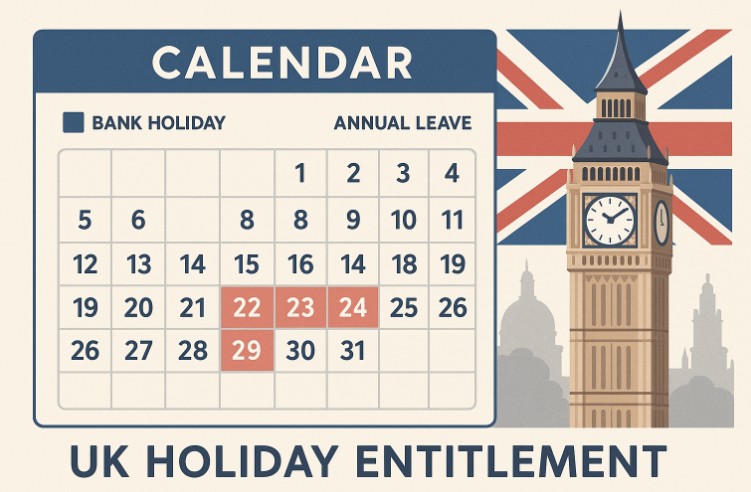
If an employee in the UK is entitled to 28 days of holiday per year, does this mean bank holidays are included, or are they given in addition to the allowance?
This is a common source of confusion for both employers and employees. The answer depends on employment contracts, statutory rights, and how a company chooses to structure its annual leave policy.
What Does the UK Law Say About Annual Leave Entitlement?
Under the Working Time Regulations 1998, all UK employees are entitled to a statutory minimum of 5.6 weeks of paid holiday each year.
For a full-time employee working five days a week, this equals 28 days. This entitlement is designed to ensure employees have adequate time away from work to rest and recover.
The 28-day entitlement can be made up of:
- Annual leave days chosen by the employee
- Bank holidays, which are public holidays recognised nationally or regionally
Employers are allowed flexibility in how they structure these 28 days. They can either:
- Count bank holidays as part of the 28 days, meaning employees have fewer days to take at their own discretion
- Offer the 28 days in addition to paid bank holidays, giving a more generous allowance
Clear wording in employment contracts is essential. Without precise terms such as “inclusive of bank holidays” or “plus bank holidays”, employees might misunderstand their entitlement, leading to disputes.
Are Bank Holidays Included in the 28 Days Annual Leave?
The answer depends entirely on the terms in the employment contract. If the contract states “28 days including bank holidays”, this usually means that the eight public holidays recognised in the UK are part of the 28 days. This would leave 20 days for the employee to book at their discretion.
If the contract says “28 days plus bank holidays”, the employee has the freedom to take the full 28 days when they choose, and bank holidays are extra.
For example:
| Contract Wording | Discretionary Days | Bank Holidays | Total Paid Days |
| 28 days including bank holidays | 20 | 8 | 28 |
| 28 days plus bank holidays | 28 | 8 | 36 |
The difference can have a significant impact on how much time an employee can take off while the business is operational.
How Many Bank Holidays Are There in the UK Each Year?
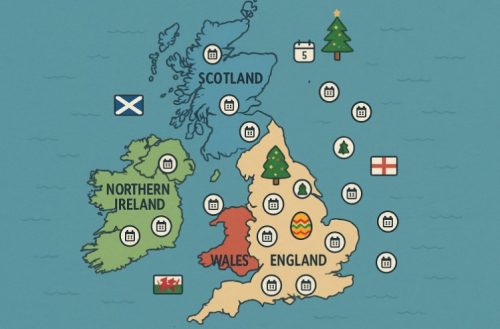
The number of bank holidays in the UK is not uniform across all regions. England and Wales typically have eight, Scotland has nine, and Northern Ireland has ten.
| Region | Number of Bank Holidays | Notable Additional Holidays |
| England & Wales | 8 | Early May Bank Holiday, Boxing Day |
| Scotland | 9 | St Andrew’s Day, 2 January |
| Northern Ireland | 10 | St Patrick’s Day, Battle of the Boyne |
Employers should take regional differences into account, especially if they operate across multiple locations.
How Do Employers Handle Bank Holidays for Part-Time Staff?
Part-time employees have the same legal right to 5.6 weeks’ paid holiday as full-time employees, but this entitlement is applied on a pro-rata basis according to the number of days or hours they work.
This ensures fairness, so part-time workers are not disadvantaged compared to their full-time colleagues.
For example:
- A full-time employee working 5 days per week receives 28 days holiday per year.
- A part-time employee working 3 days per week would receive 3 ÷ 5 × 28 = 16.8 days holiday per year.
The treatment of bank holidays for part-time staff depends on whether the company includes them within the statutory entitlement or offers them in addition.
Key Points for Employers to Consider
- If bank holidays are included in the entitlement, part-time employees may have fewer days to book at their discretion if they normally have bank holidays off.
- If bank holidays are offered separately, they should be allocated fairly, based on the employee’s working pattern.
- Pro-rata allocation is often done in hours rather than days, especially for irregular schedules, to avoid unfair advantage or disadvantage.
Example Scenario
If a company includes bank holidays within annual leave and the part-time employee works Mondays, they are likely to benefit from several paid bank holidays without needing to book leave.
However, if the employee never works Mondays, they could miss out entirely. To address this, many employers:
- Allocate a total holiday entitlement in hours, including an allowance for bank holidays.
- Require staff to deduct any bank holidays they take from their entitlement, regardless of their normal working pattern.
Example Pro-rata Calculation in Hours
- Full-time holiday entitlement: 28 days × 7.5 hours per day = 210 hours per year.
- Part-time hours: 3 days × 7.5 hours = 22.5 hours per week.
- Pro-rata holiday entitlement: (22.5 ÷ 37.5) × 210 = 126 hours per year.
This total (126 hours) includes both discretionary leave and bank holiday hours. The employee can then decide when to take this time off, with bank holidays deducted if they choose to take them off work.
By applying this method, employers can ensure consistency and fairness across the workforce, regardless of whether staff work fixed days or variable shifts.
What Happens If a Bank Holiday Falls on a Non-Working Day?
When a bank holiday falls on a day an employee does not normally work, such as a weekend or a fixed day off in their schedule, the treatment of that day depends on the employer’s policy and how the employment contract is worded.
In the UK, there is no automatic legal right to an extra day off if a bank holiday lands on a non-working day. However, many employers offer substitute days as a matter of fairness or company policy.
Typical Approaches Employers Take
- Provide a substitute day off: Often referred to as a “day in lieu,” this gives employees an alternative day off, usually within the same holiday year.
- No replacement day: If bank holidays are already counted within the total annual leave entitlement, the employer might not provide an extra day.
- Fixed public holiday closure: Some companies close on specific days regardless of individual work schedules, meaning the impact depends on whether the employee would have been scheduled to work.
Example Scenarios
1. Full-time employee, Monday to Friday schedule
- If Christmas Day falls on a Saturday, the following Monday is usually treated as a public holiday.
- The employee gets Monday off without affecting their annual leave entitlement (if the employer grants substitute days).
2. Part-time Employee, Works Tuesday to Thursday
- If a bank holiday falls on a Monday, the employee would not normally benefit from it.
- To ensure fairness, some employers calculate holiday in hours so the employee still gets an equivalent allowance.
3. Shift Worker With Rotating Days
- If a bank holiday falls on a scheduled working day, the employee can either take it as paid leave or work and receive enhanced pay/time off in lieu, depending on the contract.
Bank Holiday on a Non-Working Day – Example Treatments
| Work Pattern | Bank Holiday Falls On | Typical Employer Approach | Employee Outcome |
| Mon–Fri full-time | Saturday | Monday declared as substitute holiday | Paid day off on Monday |
| Tues–Thurs part-time | Monday | No substitute unless hours-based system | No direct benefit unless policy allows |
| Shift pattern (rotating) | Varies | Depends on rota; may get day off or extra pay | Compensation or leave given if scheduled to work |
Employers who operate across different working patterns often find it fairest to convert holiday entitlement into total hours rather than days.
This way, if a bank holiday falls on a day an employee does not usually work, they still have the flexibility to use their entitlement at another time.
This approach ensures fairness, avoids disputes, and is especially useful for part-time and shift-based workforces.
Can Employers Require Staff to Work on Bank Holidays?

There is no automatic right to time off on bank holidays. An employer can require staff to work on these days if it is stated in the employment contract. This is common in industries such as:
- Retail
- Hospitality
- Healthcare
- Emergency services
Pay arrangements vary. Some employers offer enhanced rates, such as double pay, while others offer time off in lieu. This is a matter of company policy and is not a legal requirement.
How Should Employees Check Their Contract for Bank Holiday Rights?
The annual leave clause in the employment contract should make it clear whether bank holidays are part of the overall entitlement. Employees should check for:
- Phrases like “inclusive of bank holidays” or “plus bank holidays”
- Policies on working during bank holidays
- Any sector-specific arrangements, such as for shift workers
Clear contractual language helps avoid confusion and ensures consistent application of policy.
What Are the Common Misunderstandings About Bank Holiday Entitlement?
Several misunderstandings frequently arise:
- Believing that the statutory minimum is 28 days plus bank holidays, when it is actually 28 days in total for full-time staff
- Assuming all bank holidays are guaranteed days off
- Thinking extra bank holidays are automatically given without checking contract terms
Employers can prevent these issues by clearly explaining how holiday entitlement is structured during the hiring process.
What Happens If an Extra Bank Holiday Is Created?

Occasionally, the UK government declares additional bank holidays, such as for royal events. Whether employees get the day off depends on the contract.
If the contract says “20 days plus bank holidays”, the extra day is normally granted without affecting the standard holiday allowance.
If the contract says “28 days inclusive of bank holidays”, the employer can require staff to use part of their allowance to cover the extra day.
Some businesses choose to grant all staff the extra day off as a goodwill gesture, which can boost morale and retention.
Conclusion
In the UK, 28 days is the statutory minimum annual leave for full-time employees, but whether bank holidays are included depends entirely on the employment contract.
Employers should use clear wording such as “inclusive of bank holidays” or “plus bank holidays” to avoid misunderstandings.
Employees should always check their contracts to understand exactly what they are entitled to, and employers should ensure policies are applied consistently to full-time and part-time staff.
FAQs about Bank Holidays and Annual Leave in the UK
Is 28 days annual leave the same as 5.6 weeks?
Yes, for someone working five days a week, 28 days is equivalent to the statutory 5.6 weeks’ paid holiday required by UK law.
Do part-time employees get bank holidays off?
Part-time employees are entitled to pro-rata holiday allowance, which may or may not include bank holidays depending on the contract.
Can my employer refuse time off on a bank holiday?
Yes, if your contract allows your employer to require work on bank holidays, they can refuse leave requests.
Are all UK bank holidays the same across the country?
No, Scotland and Northern Ireland have additional public holidays compared to England and Wales.
What if I work shifts that cover bank holidays?
Shift workers receive bank holiday entitlements as part of their annual leave, calculated based on their shift patterns.
Do I get paid extra for working on a bank holiday?
Not necessarily. Enhanced pay for working on a bank holiday is at the employer’s discretion unless stated in the contract.
Can I carry over unused bank holiday entitlement?
Bank holiday carry-over depends on company policy and whether they are included in your statutory leave allowance.