

























The UK government has introduced a significant increase in taxes on online gambling. It’s one of the biggest financial changes the government has introduced in the last couple of years, and it’s a part of a broader budget overhaul.
The change came about because of the sudden increase in online gambling businesses and a huge public interest in gambling, which has started to produce negative social consequences.
The government also argues that the additional taxes will pay for public services and social programs. In this article, we’ll discuss the tax rise in detail.
Why the UK Is Raising Online Gambling Taxes?
Online gambling has expanded rapidly in the last decade and has overtaken land-based casinos, which have had much smaller customer bases.
This is partly due to convenience and partly due to the rise of Bitcoin exchanges and the use of cryptocurrencies for gambling. It has made the process safe and fast, without requiring players to provide personal data.
Policy makers have long claimed that the taxes on crypto gambling are made for the previous eras of gambling practices and that they aren’t suited to online gambling using high tech to deliver the service on a mobile device.
What the Tax Changes Entail?
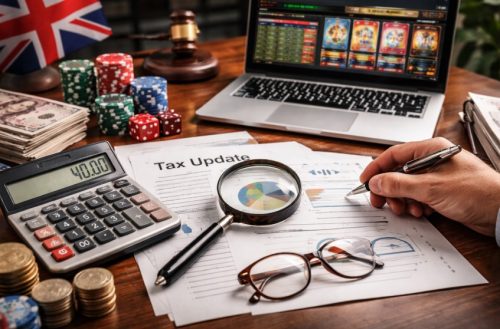 Increase in Remote Gaming Duty
The most significant change is in the increase in Remote Gaming Duty, which applies to online casino-style games. These games are among the most popular among players and include games of luck such as slots, virtual games, and live dealer games.
Starting on April 1st 2026, the duty will rise from 21% to 40% of gross gambling yield. Many feel that nearly doubling the tax shows the government is serious about the new restrictive approach.
Higher Tax on Remote Betting
Remote betting, including sports betting, will also be subject to a higher tax rate. It will increase from 15% to 25%. The bets made on horse racing are excluded from this tax, since the industry depends on revenue from betting almost entirely.
The distinction shows that the government has sought a balanced approach rather than introducing a blanket measure.
Treatment of Other Sectors
There will be no changes in taxes for land-based gambling establishments. At the same time, bingo taxes are completely cancelled starting in April of this year. The sector has been struggling for years.
Government Rationale and Official Statements
The government has presented the policy as a common-sense measure addressing a rapidly evolving industry with an outsized impact on society. Senior MPs have described the measure as a victory for common-sense regulation.
Treasury representatives have emphasised that the reforms are part of a broader effort to modernise gambling taxation. They also claim that the portion of the government revenue will be used to provide help for those struggling with gambling addiction. The tax will bring in more than £1 billion annually.
Industry Response and Criticism
The industry has reacted strongly and opposed the measure. Major gambling providers say that the funds used to pay higher taxes could be used to fund responsible gambling practice. Others have said that, in the end, the additional cost would be passed on to the end user, who won’t stop gambling because of the new measure.
Some also claim that the players may migrate to unofficial gambling sites to avoid higher taxes. Those sites don’t pay taxes and are also much less safe than those that comply with the new regulations. Industry groups maintain that the increase itself isn’t necessary and that it will require businesses to cut staff.
Potential Economic and Social Implications
 The tax spike will boost government revenue, but how the funds will be used and what impact they’ll have on society remain to be seen. There’s also a chance that higher expenses will lead to job losses and downsizing in the industry.
The government also recognises that young people are betting online more than ever, and that modern technology has increased the addictive qualities of online betting. The general public is now more in favour of stricter industry regulations.
To Sum Up
The UK will increase taxes on online betting winnings. The taxes on winnings from slots will double, and those on sports betting will increase by about a third. At the same time, ground casinos and bingo games won’t see any difference.
The industry opposes the move, and the government sees the measure as catching up with the industry and its high-tech resources.
There are those who claim that the industry will pass the burden to end users and that it will have to let go of some employees and divert funds from measures made to combat addiction.