
























There is no DWP Cost of Living Payment for 2026, and the Government says there are no further payments planned in the future under the previous Cost of Living Payment scheme.
The final means-tested instalment was £299, paid to most eligible DWP claimants between 6 and 22 February 2024.
This does not mean all cost-of-living support has ended. In 2026, help is instead available through existing benefits, energy support, pensioner payments and locally administered crisis assistance.
The Government’s official cost of living support page provides the current routes for checking available help.
| 2026 Question | Current Position |
| New DWP Cost of Living Payment? | No |
| Final Means-Tested Payment | £299 in February 2024 |
| More Payments Planned? | No current plans |
| Main 2026 Support | Benefits, energy help and local crisis support |
| England’s Local Crisis Fund | Crisis and Resilience Fund |
Last Updated: 26.08.2026
What Is the Current Status of DWP Cost of Living Payments in 2026?
The DWP Cost of Living Payment programme was introduced as temporary financial support during a period of unusually high household costs.
It provided additional lump-sum payments to people receiving qualifying means-tested benefits, with separate arrangements for some disabled people and pensioners.
By 2026, the position is much clearer than it was during 2024 and 2025. The Government states that there will be no Cost of Living Payment for 2026 and no more payments are currently planned in the future.
For households receiving Universal Credit, Pension Credit, ESA or other benefits, this distinction matters.
Being on a qualifying benefit today does not automatically give someone entitlement to another £299, £300, £500 or similarly advertised Cost of Living Payment.
People should therefore be cautious about online posts claiming a new nationwide payment is being issued.
GOV.UK also warns about messages pretending to come from government services or energy-support schemes and advises people not to provide bank details or passwords in response to suspicious messages.
The previous payments should now be viewed as a historical support programme, although a person can still have questions about an older payment if their qualifying benefit was awarded later or their circumstances were reassessed.
DWP Cost of Living Support in 2025 vs 2026 – What Has Changed?
The most significant change between 2025 and 2026 is not the introduction of another national Cost of Living Payment. Instead, the way some emergency household support is delivered has changed.
During 2025, the previous £900 means-tested Cost of Living Payment package had already finished. However, vulnerable households in England could still receive locally administered assistance through the Household Support Fund.
The final Household Support Fund period ran from 1 April 2025 to 31 March 2026, with £742 million made available to county councils and unitary authorities in England.
It was intended to help vulnerable households with essentials and provide preventative support.
From 1 April 2026, England moved to the new Crisis and Resilience Fund. The fund is scheduled to operate until 31 March 2029 and is intended to support low-income households facing financial shocks while also funding services designed to improve longer-term financial resilience.
| Area | 2025 | 2026 |
| DWP Cost of Living Payment | No new general payment | No payment and no further payments planned |
| Household Support Fund | Available in England | Ended on 31 March 2026 |
| Crisis and Resilience Fund | Not yet operating | Running from 1 April 2026 |
| Working and Child Tax Credits | Ended on 5 April 2025 | No longer paid |
| Main Support Approach | Benefits plus local assistance | Benefits plus redesigned local crisis support |
Another important change concerns tax credits. Working Tax Credit and Child Tax Credit ended on 5 April 2025, meaning they are no longer part of the active benefits system in 2026.
GOV.UK explains that people may instead qualify for Universal Credit or Pension Credit depending on their circumstances.
Who Was Eligible for the Previous DWP Cost of Living Payments?
Eligibility for the previous means-tested Cost of Living Payments depended on receiving a qualifying benefit during specific eligibility periods.
These rules remain important for anyone checking whether they should have received an older payment.
The qualifying benefits included:
- Universal Credit: Claimants had to meet the relevant assessment-period conditions for each payment
- Income-Based Jobseeker’s Allowance: Contribution-based or New Style JSA alone did not qualify
- Income-Related Employment and Support Allowance: New Style or contributory ESA alone was excluded
- Income Support: Eligible recipients could qualify if they met the relevant dates
- Pension Credit: Eligible pension-age households could qualify under the means-tested scheme
- Working Tax Credit: Historically qualified where the relevant tax-credit rules were met
- Child Tax Credit: Historically qualified where the relevant tax-credit rules were met
GOV.UK confirms that people receiving only New Style ESA, contributory ESA or New Style JSA did not qualify for these means-tested Cost of Living Payments.
What Happened to Tax Credit Eligibility?
Working Tax Credit and Child Tax Credit were included in the old Cost of Living Payment system, but this is now historical information.
Both benefits ended on 5 April 2025, and no further tax credit payments are being made.
The Government’s information on how tax credits ended in 2025 explains that former claimants may instead be able to receive Universal Credit or Pension Credit.
This means a person cannot become eligible for a new 2026 Cost of Living Payment simply by referring to an old Working Tax Credit or Child Tax Credit award.
When Were the Final DWP Cost of Living Payments Made?
The 2023 to 2024 means-tested programme consisted of three separate instalments worth a combined £900 for people who qualified for all three payments.
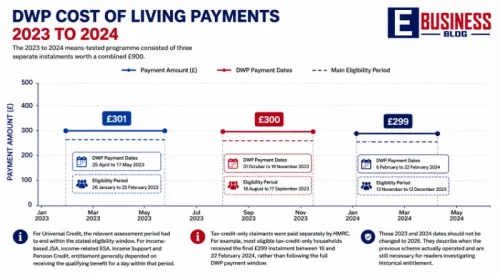
| Payment | DWP Payment Dates | Main Eligibility Period |
| £301 | 25 April to 17 May 2023 | 26 January to 25 February 2023 |
| £300 | 31 October to 19 November 2023 | 18 August to 17 September 2023 |
| £299 | 6 February to 22 February 2024 | 13 November to 12 December 2023 |
For Universal Credit, the relevant assessment period had to end within the stated eligibility window.
For income-based JSA, income-related ESA, Income Support and Pension Credit, entitlement generally depended on receiving the qualifying benefit for a day within that period.
Tax-credit-only claimants were paid separately by HMRC. For example, most eligible tax-credit-only households received the final £299 instalment between 16 and 22 February 2024, rather than following the full DWP payment window.
These 2023 and 2024 dates should not be changed to 2026. They describe when the previous scheme actually operated and are still necessary for readers investigating historical entitlement.
What Ongoing Cost of Living Support Changes Should Claimants Know About?
Although the old Cost of Living Payment programme has ended, several changes remain relevant to households seeking financial support during 2026.
Crisis Support Has Changed in England
The Household Support Fund ended on 31 March 2026. From 1 April, the Crisis and Resilience Fund became a major route for locally delivered crisis and preventative assistance in England.
Under the fund, local authorities must provide a Crisis Payment scheme for people experiencing a financial shock or at risk of falling into crisis.
Councils can also fund housing support, resilience services and activities connecting people with wider local assistance.
The exact support available can vary because councils have discretion over how funding is allocated within the national framework.
The official Crisis and Resilience Fund guidance explains the framework covering England from April 2026 to March 2029.
Tax Credits Have Fully Closed
Tax credits are no longer an ongoing source of household income.
Their closure in April 2025 means people should not rely on older Cost of Living Payment eligibility articles that present Working Tax Credit or Child Tax Credit as benefits that can still be claimed in 2026.
Energy Support Continues Separately
The Warm Home Discount remains available as a separate form of help with energy costs. For winter 2026 to 2027, it provides a £150 discount on eligible households’ electricity bills and is due to reopen in October 2026.
In England and Wales, the 2026 to 2027 eligibility rules use 23 August 2026 as the relevant date, with qualifying means-tested benefits including Universal Credit, Housing Benefit, income-related ESA and Pension Credit.
This discount is applied to an energy bill rather than being paid as a new DWP Cost of Living Payment.
What Are the Government’s Future Plans for Cost of Living Support?
There is currently no announced plan to restart the national Cost of Living Payment programme. This is an important change from older articles that described future payments as uncertain or awaiting confirmation.
The Government’s current position is more definitive. GOV.UK says there will be no Cost of Living Payment in 2026 and that no further payments are planned.
However, this does not mean government support for household financial pressures has stopped. The current approach includes existing benefits, energy-bill assistance, pensioner support and locally administered funds.
One of the clearest longer-term developments is the Crisis and Resilience Fund in England, which has been established for a three-year period running from 1 April 2026 to 31 March 2029.
Its structure combines immediate crisis payments with housing assistance and measures intended to improve financial resilience.
Therefore, readers should distinguish between:
- Confirmed Policy: No new Cost of Living Payment is planned
- Existing Support: Benefits and targeted schemes remain available
- Local Support: Crisis assistance can differ between councils
- Future Announcements: Any genuinely new national payment would need fresh official confirmation
Claims circulating online about an unannounced £300, £500 or other lump-sum DWP payment should not be treated as fact without confirmation from GOV.UK, DWP or HM Treasury.
What Financial Help Is Available Instead in 2026?
People struggling with household costs in 2026 may still have several routes to assistance, even though there is no new Cost of Living Payment.
Crisis And Resilience Fund
In England, local authorities can provide Crisis Payments to low-income households experiencing a sudden financial shock or where intervention could prevent a crisis from becoming worse.
The fund can support needs involving food, utilities, household goods and other essentials. Government guidance states that Crisis Payments should primarily use a cash-first approach, although councils retain flexibility based on individual circumstances.
Universal Credit
Universal Credit remains an important means-tested benefit for eligible people on a low income or out of work. Entitlement depends on household income, savings, housing circumstances and other factors.
Receiving Universal Credit in 2026 does not mean a separate Cost of Living Payment will automatically be added.
Pension Credit
Pension Credit can provide additional income to people over State Pension age who meet its conditions.
For 2026 to 2027, the standard minimum guarantee is £238 a week for a single claimant and £363.25 for a couple, although actual entitlement depends on individual circumstances.
Warm Home Discount
Eligible households can receive a £150 reduction from their electricity bill under the 2026 to 2027 Warm Home Discount scheme. It is a bill discount rather than a cash payment.
Winter Fuel Payment
Eligible older people can receive between £100 and £300 for winter 2026 to 2027. Most eligible people are expected to receive their payment automatically in November or December 2026.
Where an individual’s total income exceeds £35,000, HMRC will recover their Winter Fuel Payment through their tax code or Self Assessment arrangements.
Support arrangements also differ across Scotland, Wales and Northern Ireland, so households should check the schemes applying where they live rather than assuming English local-authority funding rules apply throughout the UK.
What Should You Do If an Old Cost of Living Payment Is Missing?
Although people cannot apply for a new 2026 Cost of Living Payment, questions about older payments can still arise.
GOV.UK confirms that historical payments can sometimes arrive later, including where a qualifying benefit is awarded retrospectively or payment details changed.
 If you believe an older payment is missing:
- Identify the Payment: Check whether you are looking for the £301, £300 or £299 instalment
- Check the Eligibility Dates: Confirm that your qualifying benefit covered the relevant period
- Review Bank Statements: Look for the payment and any Cost of Living Payment reference
- Check Backdated Entitlement: A benefit decision made later could affect historical eligibility
- Contact The Relevant Office: Speak to the office responsible for the qualifying benefit if you still believe payment is outstanding
Do not submit personal or banking information to unofficial websites claiming they can secure a new DWP Cost of Living Payment. There is currently no nationwide 2026 payment application process.
Conclusion
The DWP Cost of Living Payment scheme is no longer an active programme.
The final means-tested instalment was the £299 payment issued in February 2024, and the Government now confirms that there is no Cost of Living Payment for 2026 and no further payments are currently planned.
The support landscape has nevertheless continued to change. Tax credits ended in April 2025, England’s Household Support Fund finished in March 2026 and the Crisis and Resilience Fund began in April 2026.
Households facing financial pressure should therefore focus on support that actually exists in 2026, including Universal Credit, Pension Credit, local crisis assistance, the Warm Home Discount and Winter Fuel Payment where eligible.
Any announcement of a future national Cost of Living Payment should only be treated as confirmed when it appears through an official government source.
FAQs About DWP Cost of Living Payments in 2026
Is There a DWP Cost of Living Payment in 2026?
No. The Government states that there will be no Cost of Living Payment for 2026 and that no further payments are currently planned.
What Changed From 2025 to 2026 for Cost of Living Support?
England’s Household Support Fund ended on 31 March 2026 and the new Crisis and Resilience Fund began on 1 April 2026.
When Was the Last DWP Cost of Living Payment?
The final means-tested instalment was £299, paid to most eligible DWP claimants between 6 and 22 February 2024.
Can Universal Credit Claimants Get a New Cost of Living Payment?
Universal Credit claimants do not automatically receive a separate Cost of Living Payment in 2026. The previous payment scheme has ended.
What Replaced the Household Support Fund in 2026?
In England, the Crisis and Resilience Fund began on 1 April 2026 and is currently funded through 31 March 2029.
Are More DWP Cost of Living Payments Planned for the Future?
No further Cost of Living Payments are currently planned. Any future change would require a new government announcement.
What Financial Help Can I Get Instead in 2026?
Depending on your circumstances, support may include Universal Credit, Pension Credit, local Crisis Payments, the £150 Warm Home Discount and Winter Fuel Payment.