


























Yes, eligible adults can have more than one ISA, including several ISAs of the same type with different providers.
There is no overall numerical limit on ordinary adult ISA accounts. In 2026/27, total new contributions across adult ISAs must stay within £20,000.
Since 6 April 2024, savers can pay into multiple cash, stocks and shares, or innovative finance ISAs in the same tax year. Lifetime ISAs and Junior ISAs have separate restrictions.
The distinction is between how many accounts someone holds and how much new money they contribute.
Opening another account does not create another allowance, and keeping older ISAs does not use up the current year’s allowance.
How Many ISAs Can You Open and Pay Into This Tax Year?
For ordinary adult cash, stocks and shares, and innovative finance ISAs, the answer is no fixed statutory maximum number. A provider can still limit how many of its own products a customer opens.
| ISA type | Can someone hold more than one? | Can they pay into more than one in 2026/27? | Contribution limit |
| Adult cash ISA | Yes; no overall numerical limit | Yes, subject to provider terms | Part of the combined £20,000 adult allowance |
| Stocks and shares ISA | Yes; no overall numerical limit | Yes, subject to provider terms | Part of the combined £20,000 adult allowance |
| Innovative finance ISA | Yes; no overall numerical limit | Yes, subject to provider terms | Part of the combined £20,000 adult allowance |
| Lifetime ISA | Yes, accounts can be accumulated across years | Normally only one LISA can receive subscriptions in a tax year; formal transfers have separate rules | £4,000, included within the £20,000 adult allowance |
| Junior cash ISA | Only one at a time per child | No, except changing provider through a formal transfer | Shares the child’s separate £9,000 Junior ISA allowance |
| Junior stocks and shares ISA | Only one at a time per child | No, except changing provider through a formal transfer | Shares the child’s separate £9,000 Junior ISA allowance |
A child can therefore hold two Junior ISAs in total: one cash and one stocks and shares. The £9,000 limit is shared between them, rather than available separately for each.
Adult ISA eligibility normally requires someone to be at least 18 and UK resident, with exceptions for qualifying Crown employees and their spouses or civil partners. A first Lifetime ISA must be opened before age 40, and contributions can continue until age 50.
Can You Have Two Cash ISAs With Different Banks?
Yes. Two cash ISAs with different banks are permitted, and both can receive new contributions during the same tax year. They can both be easy-access accounts, both fixed-rate accounts, or a mixture.
The April 2024 change removed the general restriction on subscribing to only one ISA of each ordinary adult type per tax year. It did not give every provider an obligation to offer multiple accounts within its own product range.
Example 1: Two Easy-Access Cash ISAs
A saver opens two accounts during 2026/27:
- £6,000 goes into an easy-access cash ISA with Provider A for emergencies.
- £7,000 goes into another easy-access cash ISA with Provider B for a house deposit.
- Total new ISA contributions are £13,000, leaving £7,000 of the annual allowance.
This arrangement is permitted. Neither account needs to be a fixed-rate product, and the accounts do not need to be opened in different tax years.
Example 2: Two Fixed-Rate Cash ISAs
Another saver puts £8,000 into a one-year fixed-rate cash ISA and £12,000 into a two-year fixed-rate cash ISA during 2026/27.
The £20,000 total uses the full allowance. Different maturity dates may help with planning, but early access can involve interest penalties. Opening a third ISA would not create room for more new contributions that year.
Example 3: Two Investment ISAs Alongside Cash Savings
A saver contributes £5,000 to one stocks and shares ISA, £7,000 to another and £8,000 to a cash ISA.
The total is £20,000, so the account combination is permitted. However, two investment platforms can hold overlapping funds: using different providers does not automatically diversify the underlying investments.
These examples illustrate account rules, rather than recommend particular allocations. Investments can fall in value.
Does Every ISA Have Its Own £20,000 Allowance?
No. The ordinary annual allowance belongs to the individual and is shared across their adult ISAs.
For someone considering whether they can put £20,000 in an ISA every year, the allowance resets on 6 April. Unused allowance from the previous tax year cannot normally be carried forward.
| Account receiving new money | Contributions in 2026/27 |
| Cash ISA A | £4,500 |
| Cash ISA B | £3,500 |
| Stocks and shares ISA | £8,000 |
| Lifetime ISA | £4,000 |
| Total | £20,000 |
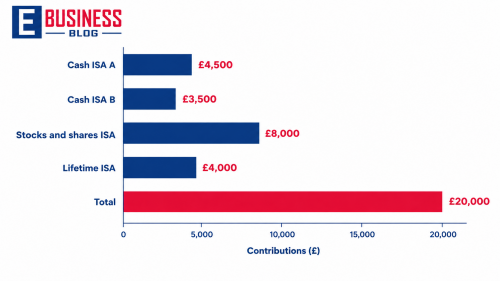 The Lifetime ISA payment is included in that total. Its government bonus does not use additional contribution allowance. Knowing when the government bonus is paid on a LISA can help distinguish personal payments from bonus credits when checking statements.
Interest credited inside an ISA and investment growth are not fresh subscriptions. An ISA balance can therefore exceed £20,000 without breaking the annual contribution limit.
How Will the April 2027 Cash ISA Changes Affect Multiple Accounts?
The government has announced changes due from 6 April 2027, subject to the legislation implementing them. These should not be confused with the rules applying in 2026/27.
| Rule | 2026/27 | Announced position from 6 April 2027 |
| Overall adult ISA allowance | £20,000 | £20,000 |
| Ordinary cash ISA subscriptions | Up to £20,000 within the overall allowance | £12,000 in aggregate for those below the age exemption |
| Age exemption | No reduced cash allowance to apply | £20,000 cash allowance from the start of the tax year in which the saver turns 65 |
The proposed £12,000 limit is per person across cash ISAs, not per account. For example, £5,000 into one cash ISA and £7,000 into another would use it fully. Opening a third would not increase it.
Existing cash ISA savings are expected to retain their tax protection. Someone holding £45,000 across three cash ISAs would not have to withdraw £33,000: the cap concerns new annual subscriptions, not total holdings.
Interest earned inside those cash ISAs would not consume the new contribution allowance.
Someone using the £12,000 cash allowance could use remaining overall allowance in other eligible ISA types, within their rules. They would not be required to invest the remainder.
What Happens in the Year Someone Turns 65?
The announced exemption starts at the beginning of the tax year containing the 65th birthday. A saver turning 65 on 10 December 2027 would qualify from 6 April 2027, rather than waiting until December.
For those below the exemption, transfers from non-cash ISAs into cash ISAs are also due to be restricted. Cash-to-cash and cash-to-non-cash transfers remain possible.
Separate announced measures cover interest on uninvested cash and wholly money-market-fund portfolios in non-cash ISAs, so an investment ISA should not be assumed to offer an unrestricted substitute for a cash ISA.
Can You Have More Than One Lifetime ISA?
Yes, someone can hold Lifetime ISAs opened in different years. However, they can normally subscribe to only one Lifetime ISA in a tax year, with a £4,000 annual payment limit.
Having an older cash LISA and a newer investment LISA does not permit contributions to both during the same year. A formal LISA transfer can allow a change of provider, but the receiving provider should confirm how current-year subscriptions must be handled.
A Lifetime ISA is also unsuitable as an unrestricted emergency fund. Withdrawals generally face a 25% charge unless they meet the qualifying first-home rules, occur from age 60, or qualify under the terminal-illness provisions.
That charge can remove part of the saver’s original contribution as well as the bonus.
Should You Open Another ISA or Transfer an Existing One?
The decision depends on whether the saver wants to add new money or move money already held inside an ISA.
flowchart TD
A[“What is the aim?”] –> B{“Move existing ISA savings?”}
B –>|Yes| C[“Ask the receiving provider for a formal transfer”]
B –>|No| D{“Which account will receive new money?”}
D –>|”Ordinary adult ISA”| E[“Multiple accounts permitted; check shared allowance”]
D –>|”Lifetime ISA”| F[“Normally subscribe to one per tax year; £4,000 limit”]
D –>|”Junior ISA”| G[“One of each type per child; £9,000 combined”]
The decision tree describes 2026/27. Provider terms, eligibility and the announced 2027 cash restrictions must also be checked where relevant.
Can Three Older Cash ISAs Be Consolidated Into One?
Yes, if the receiving provider accepts them. Suppose three cash ISAs from earlier tax years hold £9,000, £14,000 and £18,000. Formal transfers could consolidate the £41,000 into one cash ISA without using the current year’s ordinary subscription allowance.
The saver should:
- Choose an account accepting transfers from other providers.
- Check rates, access conditions and any early-exit charges.
- Submit transfer instructions for each existing ISA to the receiving provider.
- Let the providers move the money within the ISA system.
Withdrawing everything into a current account and paying it into the new ISA is not equivalent. It can lose the money’s existing ISA protection and make the new deposit count against annual allowance.
Ordinary adult ISA rules permit full or partial transfers of current-year or previous-year money, although provider support varies.
Current-year subscriptions already made still count towards the annual limit after transfer; they are not counted twice or erased. Lifetime and Junior ISA transfers have additional restrictions.
What Are the Advantages and Disadvantages of Multiple ISAs?
| Potential advantage | Practical downside to consider |
| Separate accounts for emergencies, a house deposit and longer-term plans | More logins, statements and account details to maintain |
| Access to different rates and product terms | Introductory rates or fixed terms can expire at different times |
| Different maturity dates for planned spending | Early access to fixed-rate money may reduce interest earned |
| Access to different investment platforms | Fees may be duplicated and investments may overlap |
| Cash spread across separately authorised institutions | Different bank brands may share one protection limit |
| Less reliance on one provider’s app or service | No single provider necessarily sees the saver’s total contributions |
Multiple ISAs are most useful when each account has a clear purpose. Opening accounts simply because it is permitted can create unnecessary administration.
Does Spreading Cash ISAs Improve FSCS Protection?
It can. Since 1 December 2025, standard FSCS deposit protection has been £120,000 per eligible person, per authorised bank, building society or credit union. The older £85,000 figure is out of date for a current article.
Eligible cash ISA deposits are combined with other eligible deposits at the same institution. Two banking brands sharing one authorisation do not normally provide two separate limits.
For example, £95,000 in cash ISAs plus £35,000 in ordinary savings at the same authorised institution totals £130,000. That is £10,000 above standard protection, before considering any qualifying temporary-high-balance rules.
Spreading deposits between separately authorised institutions can improve coverage. The deposit limit must not be applied indiscriminately to investment ISAs: protection depends on the product and circumstances, and ordinary investment losses are not covered.
What Happens if Someone Accidentally Exceeds the ISA Limit?
An oversubscription does not automatically invalidate every ISA someone owns. An otherwise valid ISA can often be repaired by removing excess subscriptions and associated returns.
For example, £12,000 paid into one ISA and £9,500 into another means £21,500 contributed: an excess of £1,500.
The saver should stop further payments, collect contribution records and contact the provider. For a current-year excess, providers can arrange a correction under HMRC guidance. Earlier-year errors generally require HMRC instructions, with an opportunity to query the reported information.
Returns attributable to invalid subscriptions can lose tax exemption; actual tax depends on the applicable allowances and circumstances.
Valid money can remain protected after repair. Where repair is unavailable, invalid subscriptions may be voided and removed. Valid subscriptions from other years are not automatically affected.
Simply withdrawing £1,500 does not necessarily complete the correction. The provider must handle reporting and associated returns.
Duplicate LISA payments or excess LISA subscriptions need specific treatment, including recovery of any wrongly paid bonus. Savers should not attempt an ordinary LISA withdrawal to fix them themselves.
Can Self-Employed People Have Multiple ISAs?
Yes. Self-employment does not create a separate ISA account limit or an additional annual allowance. A person with freelance income and employment income still has one shared personal ISA allowance.
A practical arrangement might use one easy-access cash ISA for household emergencies and another for a planned personal expense. With irregular income, the saver could make contributions after retaining enough money for tax bills and business commitments.
Moving sole-trader profits into an ISA does not make the contribution a deductible business expense or remove the tax due on those profits.
A limited company cannot hold a personal ISA: company money and a director’s personal funds must be treated separately.
Goal-based accounts are an organisational choice. The right access terms matter more than the number of accounts, especially where money may be needed for a known bill.
Do Workplace ISAs or Employee Share Schemes Give an Extra Allowance?
No. A workplace ISA arranged through an employer still uses the employee’s personal ISA allowance. Payroll payments into it must be added to subscriptions made independently elsewhere.
For example, £250 per month into a workplace ISA totals £3,000 over 12 months. A further £10,000 into a personal cash ISA would bring annual contributions to £13,000.
Employee share schemes have a specific exception allowing qualifying shares from a Share Incentive Plan or Save As You Earn scheme to move directly into an ISA within the applicable 90-day window.
Their value at transfer counts towards the ISA allowance. This differs from transferring money already inside an ISA, which does not create a fresh subscription.
How Can Savers Track Contributions Across Several ISAs?
A single contribution record helps prevent different provider dashboards from creating a misleading impression of unused allowance.
| Item to record | Why it matters |
| Provider and ISA type | Identifies every account receiving money |
| Date and amount of each new subscription | Allocates payments to the correct tax year |
| Standing orders and workplace payments | Captures regular amounts that are easy to overlook |
| Formal transfers | Keeps movements of existing ISA money separate |
| Interest, investment returns and LISA bonuses | Avoids counting returns as personal contributions |
| Withdrawals and permitted replacements | Prevents incorrect assumptions about restored allowance |
An ordinary withdrawal does not automatically restore contribution room. A non-flexible ISA treats a later deposit as a new subscription.
A flexible ISA can permit qualifying replacements in the same tax year without using extra allowance, but its rules must be followed.
In particular, previous-year money normally needs to be replaced into the same flexible ISA from which it was withdrawn.
Checking the combined record before each lump-sum payment is more reliable than assuming each provider’s displayed allowance accounts for subscriptions elsewhere.
Frequently Asked Questions
Can I Have Two ISAs With Different Banks?
Yes. Multiple ordinary adult cash or investment ISAs can be held and funded with different providers, within the combined annual allowance. Lifetime ISAs have additional subscription restrictions.
Can I Open Two Cash ISAs in the Same Month?
Yes, subject to provider terms. There is no general waiting period between opening ordinary cash ISAs; total contributions remain the key limit.
Does Having Multiple ISAs Affect My Credit Score?
Simply holding several ISAs does not normally damage a credit score. ISAs are savings or investment accounts rather than borrowing, although providers may perform identity checks when opening them.
Can I Have an ISA and a Normal Savings Account?
Yes. Ordinary savings deposits do not use ISA contribution allowance, although interest outside an ISA may be taxable depending on the saver’s allowances and circumstances.
Can I Keep an Old ISA Without Paying Into It?
Yes, subject to its terms. Existing ISA money can remain protected without an annual contribution, and a fixed-rate account’s maturity does not itself require the money to leave the ISA system.
Can Couples Have a Joint ISA?
No. ISAs are individual accounts. Two eligible adults each have their own allowance, which is £20,000 each in 2026/27; neither receives extra personal allowance merely because the other leaves theirs unused.
Will the £12,000 Cash ISA Cap Apply to Each Account From 2027?
No. Under the announced rules, it applies to combined new ordinary cash ISA subscriptions for those below the age exemption. It does not impose a £12,000 ceiling on existing balances.