

























There’s a version of this conversation that happens in boardrooms and another that happens in engineering offices. In boardrooms, it’s about ESG targets, carbon reporting obligations, and what the regulatory landscape looks like in 2030.
In engineering offices, it’s about vent streams, recovery rates, and whether the capital cost of a new separation unit pencils out against current gas prices.
Both conversations are pointing at the same physical reality: a lot of valuable gas goes up the stack.
How Is Cryoin Europe Turning Vent Streams Into Profit?
The Byproduct Problem in Air Separation
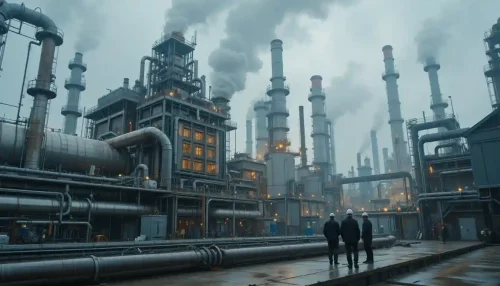 Large-scale cryogenic air separation plants are optimised for their primary products – typically oxygen, nitrogen, and argon. The rare gases present in atmospheric air at trace concentrations – krypton, xenon, neon, and helium fractions, end up in various waste streams, often vented.
Historically, recovering these required additional capital investment that only made sense above certain production scales or during periods of high noble gas prices.
That calculus has shifted. Xenon spot prices have been volatile but structurally elevated. Krypton demand from the display and semiconductor industries has grown.
And on the regulatory side, emissions accounting has become more rigorous, not because noble gases are greenhouse gases in the conventional sense, but because comprehensive emissions tracking increasingly covers all vent streams, not just CO₂.
Cryoin Europe works with operators of air separation infrastructure to evaluate recovery economics across their specific plant configurations, gas compositions, and target product specifications.
Recovery Economics: The Inputs That Actually Matter
Generic statements about “monetising waste streams” aren’t particularly useful to a plant manager who needs to present a capital justification. The relevant inputs are more specific.
Tail gas composition varies significantly between ASU designs, operating loads, and feedstock air quality. A recovery unit sized for one plant’s output may be substantially over- or under-built for another.
Cryoin Europe’s evaluation process starts with actual feedstock characterisation rather than assumed typical values – because the difference between a viable project and an uneconomic one often comes down to whether krypton concentration in the waste stream is 5 ppm or 15 ppm.
Product specification requirements also affect project economics. Recovering a crude Kr/Xe fraction is one thing; purifying it to semiconductor-grade is another, with corresponding differences in equipment scope, energy consumption, and achievable margin per unit volume.
Operating cost profile matters as much as capital cost. Cryogenic separation is energy-intensive, and electricity price assumptions significantly affect long-term project returns. Cryoin Europe’s engineering assessments include operating cost modelling alongside capital expenditure estimates.
Environmental Dimension: Beyond Carbon Accounting
 The environmental argument for industrial gas recovery isn’t primarily about greenhouse gas emissions – it’s about resource efficiency and the energy cost embedded in production.
Xenon and krypton, once vented, are gone. Recovering them from atmospheric air again requires running a very large cryogenic plant for a very long time to accumulate a few kilograms of product.
The energy intensity of noble gas production from primary sources is substantial. Recovery from existing process streams avoids that embedded energy cost entirely.
For facilities operating under ISO 14001 environmental management frameworks or reporting against GRI standards, quantifying and reducing resource losses, including valuable byproduct gases, is part of the compliance and reporting structure.
Recovery projects can contribute measurably to these metrics, which matters for industrial operators with public sustainability commitments.
Cryoin Europe’s positioning in this space connects the operational (process gas recovery and purification) to the reporting dimension, providing the documentation and traceability that environmental audits require.
Gas Recycling in Process Industries
Recovery economics apply beyond air separation. Several industrial processes consume noble gases in applications where recycle loops are technically feasible but operationally complex.
Xenon in lighting and medical imaging applications and krypton in certain laser systems represent post-use gas streams that, with appropriate collection and purification infrastructure, can re-enter the supply chain rather than being disposed of.
The economics depend heavily on local gas prices, collection logistics, and the purity of the recoverable stream.
Cryoin Europe’s purification capability is relevant here: reclaimed gas from process use often contains contaminants that require removal before the gas meets specification for resale or reuse.
The company handles reprocessing of customer-returned gas, which reduces total supply chain waste and can provide cost benefit to the returning party depending on commercial arrangements.
The Business Model Question
 There are several commercial structures through which industrial gas recovery projects get financed and operated. Direct capital investment by the facility operator, with Cryoin Europe as equipment supplier and technical partner.
Tolling arrangements, where the operator provides feedstock and receives a product share or processing fee. Offtake agreements that provide revenue visibility sufficient to support project financing.
Which structure makes sense depends on the operator’s capital position, risk appetite, and strategic interest in becoming a gas producer versus remaining a gas consumer. Cryoin Europe works across these models rather than prescribing a single commercial approach.
Regulatory Trajectory
European industrial emissions regulation has been moving in a consistent direction: broader scope, more granular reporting, tighter enforcement.
The Industrial Emissions Directive revisions, evolving BAT (Best Available Techniques) reference documents, and national implementation of EU environmental frameworks are all relevant to operators of large industrial gas facilities.
Recovery of valuable byproduct streams is increasingly likely to be viewed as a BAT-aligned practice rather than an optional enhancement. Getting ahead of that regulatory trajectory, rather than responding to it, is the more economically rational position for facilities where the recovery economics are already marginal.
Closing Note
The intersection of environmental compliance pressure and industrial gas market economics has created a genuine business case for recovery projects that didn’t exist a decade ago. It’s not a theoretical argument about sustainability; it’s a practical calculation about vent stream composition, purification costs, product value, and regulatory exposure.
Cryoin Europe occupies a specific position in this space: technical capability across the recovery and purification value chain, commercial flexibility on project structure, and market access to convert recovered gas into revenue. For industrial operators sitting on vented noble gas streams, that combination is worth evaluating concretely rather than in principle.