


























Startups rarely fail due to a lack of ideas. More often, they struggle to maintain product quality while working quickly. Speed is key in the beginning.
Teams quickly push new features, test on the fly, and iterate on user feedback. This strategy is effective until growth begins to crack. Bugs begin to creep into production, releases become less predictable and users notice.
You can identify the pattern. An aspect that was working last week fails after a new update. A payment stream breaks down under load.
A mobile experience does not act the same way on different devices. These are not single problems, they are symptoms of systems that are changing at a rate that testing processes are unable to keep up.
Simultaneously, startups have actual limitations. Small teams, limited budgets, and the need to deliver products on a regular basis mean it is hard to develop a fully grown QA department within an organization.
It is at this point that external QA partners come in handy. The right testing partner assists startups in being fast without losing control over quality.
They introduce orderly procedures, automation possibilities, and the capacity to expand testing with the expansion of the product. This article highlights five QA companies that work well with fast-growing startups – teams that need to move quickly, but cannot afford instability.
Key Factors Startups Should Look for in a QA Partner
Agility and speed
 Startups do not have predetermined release schedules. Features are delivered on a continuous basis, priorities shift rapidly and testing must keep up with changing priorities.
A good QA partner must be in a position to integrate into this environment without dragging things down. It implies brief onboarding processes, adaptable workflows, and the capacity to change the scope of testing when the priorities change.
When testing is a bottleneck, it will be counterproductive.
Automation Capabilities
Fast product evolution cannot be maintained by manual testing. Automation enables teams to test the fundamental workflows without the need to work harder.
It also offers quicker feedback in the development cycles, particularly when incorporated in CI/CD pipelines. In the case of startups, automation does not mean perfection, but rather reliably covering the most important routes.
Scalability
What is tested on the MVP level seldom works on scale. With the increase in the number of users and features, the test requirements also increase.
A QA partner must have the capability to scale resources, add more sophisticated testing plans, and enable new environments without interfering with development.
Scalability does not simply mean the size of the team. It is about changing the testing strategy as the product matures.
Cost-effectiveness
Startups are run on a shoestring budget. Investments in QA should be both quality, and budget-conscious. This means finding a partner who will provide significant outcomes without excessively high overhead costs.
The size of the team is not always a significant difference when it comes to efficient processes and automation.
Integration with Teams
QA is most effective when it is a part of the product team. A good partner works hand in hand with the developers, product managers and designers.
Communication must be concise, quick, and in line with current workflows. Lack of proper integration brings friction. A good integration enhances speed and quality.
The 5 Top QA Testing Companies for Startups
1. DeviQA
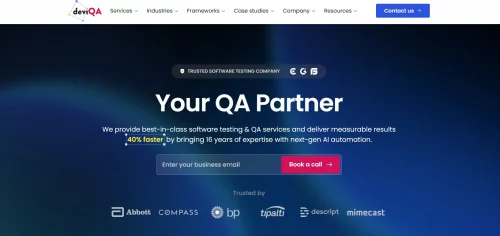
DeviQA aims at developing QA processes that change with expanding products.
This strategy is important for startups that have transitioned from MVP to full-scale release. Rather than using a fixed testing model, they help organize QA so that it can be rapidly iterated and stable at the same time.
Their services include automation, manual testing, and QA consulting. One of their strengths is the ability to incorporate testing into development processes, which helps teams avoid surprises in the late stages.
This renders them a good fit with startups that are growing fast and require testing to maintain product complexity.
2. QA Mentor
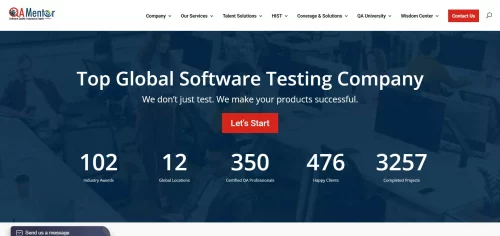 QA Mentor provides standardized processes of QA services. Being an ISO-certified company, they introduce some degree of consistency, which can assist startups in formalizing their testing approach.
They have experience in automation, performance, and security testing, which are more significant as products increase.
They also offer consulting and training, which may be helpful in cases where startups are interested in developing internal QA in the long run.
QA Mentor can also be a good choice when the team requires both execution and process improvement.
3. Appsierra
 Appsierra is focused on flexibility and speed, which is backed by AI-based automation strategies. They operate on web, mobile, and cloud platforms and assist startups in testing applications under various environments without having to create large internal teams.
Their engagement models are made to suit the evolving needs, which is significant in the case of startups, where priorities change very often. Appsierra will especially fit the teams that require rapid testing cycles and rapid scaling of testing activities.
4. Testlio
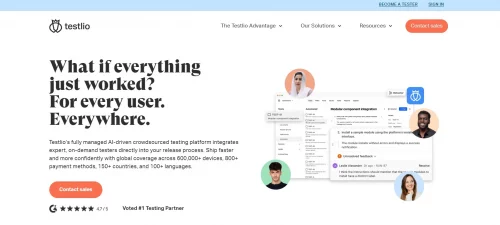 Testlio works with a decentralized network of QA specialists. This model enables startups to have access to on-demand testing without lengthy onboarding procedures. Testing can be scaled up or down based on the release cycles and requirements of the product by the teams.
Testlio is concerned with actual testing situations, which may include a variety of devices, locations, and conditions of users. This flexibility can be an important benefit to startups that are expanding to new markets or require quick feedback in a variety of environments.
5. QASource
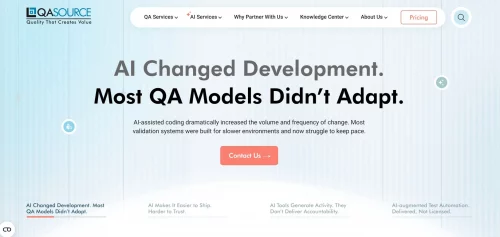 QASource offers affordable QA outsourcing that is highly focused on automation and performance testing. They assist startups with products in their early stages to mature and continue to be stable as the system matures.
Their services consist of functional testing, automation, security testing, and performance validation. QASource is often chosen by startups looking for a balance between affordability and comprehensive testing support.
Conclusion
For start-ups that grow quickly, QA is not just a support activity, it’s a stabilizer. Testing must keep up with changing products and release speeds. Without a systematic strategy, flaws pile up, the user experience deteriorates, and growth becomes more difficult to maintain.
The companies presented here have various strengths, but they all have one thing in common, the ability to enable speed while maintaining quality.
Startups must consider agility, scalability, and cost-effectiveness when selecting a QA partner. The goal is not only to test features but also to develop a testing strategy that grows with the product.
An appropriate QA approach enables teams to work quickly and efficiently, minimizing risk and contributing to long-term expansion.