

























Wondering which vacation-rental franchise could earn you steady commissions in 2027—without tying up cash in a property? We’ve sifted every 2026 Franchise Disclosure Document, tallied net openings, and dissected each fee stack to surface seven brands that still look solid for the year ahead.
Our analysis factors in Airbnb’s 15.5 percent host-only fee, stricter local permits, and Casago’s 2025 acquisition of Vacasa. Keep reading and you’ll see precise start-up costs, real-world royalty math, and—crucially—who owns the Airbnb reviews if you ever exit.
Vacation Rental Franchise Opportunities at a Glance
See every contender on one screen before we dive into the details. The table spotlights what investors ask first: cash required, ongoing fees, active markets, and the owner profile each brand aims to serve.
| Rank | Brand | Core geography | Startup cost* | Royalty + required fees* | Active territories** | Item 19? | Ideal owner profile |
| 1 | SkyRun | United States | $105k–$154k | 5 percent royalty, 1 percent brand fund | ≈ 40 | Yes | Hands-on local entrepreneur who wants autonomy with national tech |
| 2 | Grand Welcome | United States | $71k–$190k | 7–8 percent royalty, tech and guest-service stack | ≈ 65 | Yes | Sales-driven owner-operator aiming for rapid territory growth |
| 3 | iTrip | United States | $112k–$153k | 4–6.1 percent royalty, 0.5–1 percent marketing | ≈ 100 | Yes | Home-based operator focused on digital distribution |
| 4 | Casago | North America & Caribbean | $23k–$1.28M† | 3.5 percent royalty, per-property tech | ≈ 125 (franchised) | Yes | Existing manager seeking scale and enterprise tools |
| 5 | Pass the Keys | United Kingdom & Spain | £30k–£40k | Undisclosed royalty, about 18 percent homeowner fee | ≈ 80 | Limited | UK entrepreneur with a strong local network |
| 6 | Property Management Inc. | United States | $102k–$166k | Multi-pillar royalties, 2 percent brand fund | 400+ | Yes | Diversification-minded owner who wants long-term PM too |
| 7 | Direct Booker | Europe & Latin America | N/P | N/P | 27 | No | International operator considering a tech-plus-brand play |
- Figures come from the latest publicly available 2026 disclosures and must be re-verified against 2027 Franchise Disclosure Documents.
** “Active territories” counts only franchised locations, not corporate or acquisition inventory.
† Casago’s range excludes legacy Vacasa offices that are still awaiting conversion.
These numbers set the picture, yet they hide the full fee stack and support quality that determine real margins. We unpack those details in each profile.
How We Ranked the Top Vacation-rental Franchises?
We first removed any outfit that sells only software, runs all units in house, or has merged into another brand. The shortlist now contains only true franchises with a 2027 disclosure.
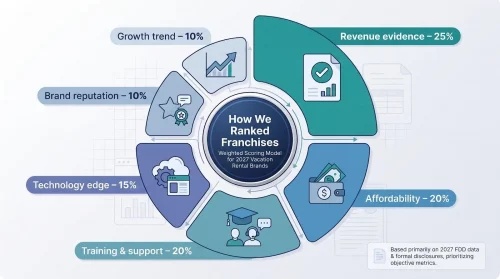 Next, we graded each candidate against six weighted factors:
- Affordability (20 percent) – total start-up cash plus the drag of recurring fees.
- Revenue evidence (25 percent) – Item 19 performance or another audited data set.
- Training and support (20 percent) – launch boot camps, ongoing coaching, and round-the-clock operational help.
- Technology edge (15 percent) – pricing engines, permit tracking, and owner portals.
- Brand reputation (10 percent) – review volume and verified owner referrals.
- Growth trend (10 percent) – net openings after we subtract closures and reacquisitions.
undefined The most recent Franchise Disclosure Document always outranks third-party sources.
We also treat three cash concepts separately: homeowner booking revenue, the management-fee slice you keep, and profit after expenses. Mixing them inflates expectations and skews budgets.
1. Skyrun: Local Control With National Firepower
SkyRun lets you run a hometown brand while headquarters handles the heavy work: multi-channel distribution, pricing analytics, and property-management software.
 Money in. The 2026 FDD lists total start-up capital of $105,080–$153,980, including a $75,000 franchise fee.
Ongoing charges stay lean at five percent royalty plus a one-percent brand fund, both applied only to the management commission you keep rather than the guest’s full booking.
Support. A month-long remote boot camp flows into a 12-week sales sprint; more than 60 OTAs feed inventory, and in-house revenue managers tune nightly rates so you’re not pricing alone.
Watch points. Item 19 shows top-line revenue but not net profit, and the company claims “tens of thousands” of five-star reviews without publishing a weighted network average.
Ask how many new franchisees reach 40 managed homes within two years, and what distinguishes those who succeed from those who stall.
2. Grand Welcome: High-support, Sales-focused Growth
Grand Welcome blends a polished national brand with a playbook that treats homeowner acquisition like a contact sport.
Money in. The 2026 Franchise Disclosure Document lists total start-up capital of $71,000–$189,750, driven by territory size and mandatory launch marketing of $3,000–$18,000 for the first three months.
Ongoing charges run just over seven percent royalty plus technology, guest-service, and brand-fund fees. Confirm the exact percentages in the 2027 FDD.
Support. New owners finish a two-week virtual academy on systems, pricing, and regulation, then rely on a 24/7 guest-services center and corporate revenue managers who adjust nightly rates while you sign the next homeowner.
Scale check. Public sources show about sixty-five territories and more than 2,300 properties. Ask for the split among corporate, conversion, and new franchises; resources only help if they keep pace with expansion.
Fit. Pick Grand Welcome if you enjoy pitching, signing, and nurturing owners while headquarters handles late-night guest messages. Before you commit, request one figure: your effective share of gross booking revenue after every recurring fee.
3. Itrip: Home-based, Technology-forward Specialist
What it is. iTrip attracts owners who want to run a lean home office while drawing on a distribution engine that feeds listings to more than 80 websites and funnels every review into one dashboard.
Money in. The 2026 Franchise Disclosure Document lists total start-up capital of $112,000–$153,000 and advises at least $50,000 in liquid funds.
Ongoing fees run four to 6.1 percent royalty plus a small national-marketing contribution. Confirm whether each percentage applies to gross booking value or only the commission slice you keep.
Support. Training starts online, moves to a field immersion week, and continues with monthly coaching calls. A central response team handles after-hours guest messages so you can focus on owner relationships.
Scale check. iTrip reports more than 100 destinations and roughly 4,500 properties. Review Item 20 to see how many markets are franchisee-run; organic growth matters more than acquisitions.
Fit. Choose iTrip if digital reach and home-office efficiency matter more than a large storefront, but compare its royalty plus marketing fee to the expense of building a similar tech stack with independent PMS tools before you decide.
4. Casago: Scale, Technology, and Post-merger Unknowns
Context. Casago completed its Vacasa acquisition on May 1, 2025, pushing the combined portfolio past 40,000 homes.
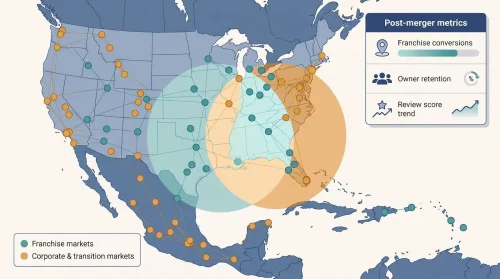
Only about 125 of those markets operate under a franchise contract; the rest remain corporate or in transition, so focus on organic franchise growth, not total inventory.
 Money in. Public 2026 sources list standard launch costs at $23,000–$1,287,000, depending on territory size and whether you take over a legacy Vacasa office.
Ongoing fees run 3.5 percent royalty plus about $99 per property for technology. Confirm any post-merger changes in the 2027 FDD.
Support. Franchisees gain an owner-acquisition CRM, channel-level pricing controls, and group-buying power for linens, supplies, and insurance, all difficult for independents to match.
Watch points. Systems and brand standards are still merging. Ask for specific metrics: how many Vacasa offices have converted to franchises, what percentage of owners stayed six months after conversion, and how review scores changed.
Fit. Pick Casago if you already manage homes and need stronger tech and purchasing scale. Bring a spreadsheet that weighs both the upside of volume and the cost of integration.
5. Pass the Keys: National Credibility for UK Short-let Entrepreneurs
What it is. London, Edinburgh, and other tightly regulated UK hubs make owner trust hard to win. Pass the Keys, operating since 2015, claims about eighty territories across Britain and Spain.
Money in. The 2026 prospectus lists total start-up capital of £30,000–£40,000, including working capital. That figure covers training, the initial licence, and a locally branded site that plugs into the franchisor’s PMS and revenue-management engine.
Economics. Franchisees usually charge homeowners about 18 percent of booking value plus VAT and keep the spread after paying an undisclosed head-office royalty. Ask for the 2027 agreement to confirm that slice before you model margins.
Support. The tech stack offers dynamic pricing, cleaner-dispatch apps, and permit alerts. Request a live demo that shows a price change flowing from market data to Airbnb in real time; proof matters more than a marketing label.
Execution test. The brand promotes a “six steps to fifty properties” launch playbook, but progress depends on relentless owner outreach and reliable Saturday-turn service partners.
If you already know estate agents, removal firms, and local cleaners, you start ahead; if not, budget extra time and cash.
Fit. Pass the Keys suits UK entrepreneurs who want national credibility without seven-figure capital. Due diligence: confirm the royalty, quiz current franchisees on time to break even, and model London-level cleaner and linen costs before you sign.
6. Property Management INC.: Diversify Your Income, Hedge Your Bets
What it is. PMI sells one franchise agreement that gives you access to five service lines: long-term residential, commercial, community associations, real-estate sales, and short-term rentals. This mix lets you shift focus if regulators restrict nightly stays.
Money in. The 2026 Franchise Disclosure Document lists total start-up capital of $102,000–$166,000, including a $69,900 franchise fee; it also recommends at least $75,000 in liquid cash and $150,000 net worth.
Royalties vary by pillar, and a two-percent brand fund applies across the board, so add it to your model before you celebrate any headline discount.
Support. New owners complete about 100 classroom and field hours, then join a mentorship program with experienced operators. The playbook highlights cross-selling so each door can earn multiple revenue streams.
Watch points. Because short-term rentals are only one slice of PMI’s offer, specialty tools such as dynamic pricing or permit tracking may lag behind pure-play competitors. Budget for third-party software or feature requests.
Fit. Choose PMI if you value diversification and want a safety net against local STR bans. During discovery, ask how many current franchisees run a profitable vacation-rental pillar and what share of total revenue it provides.
7. Direct Booker: International Watch-list Opportunity
What it is. Croatia-based Direct Booker combines a white-label booking engine (Booker Tools) with a light franchise brand now active in 27 territories across 13 countries, making it one of the few European-led choices for cross-border operators.
Money in. The franchisor does not publish start-up or royalty figures in its 2026 materials, so your first task is to request the 2027 prospectus and a full fee ladder before any further discussion.
Support. Training runs five intensive days in Dubrovnik, then shifts to on-call assistance. The model assumes you already manage homes and mainly need tech, distribution, and a recognised badge.
Evidence gap. Brochures claim break-even at ten properties and pay-back inside twelve months, but those numbers are unaudited. Ask active franchisees for real P&Ls and Owner-Review retention rates.
Fit. Keep Direct Booker on your radar if you operate in Croatia, Spain, the Adriatic islands, or Latin America and value channel connectivity over a heavyweight consumer brand. Step away if the franchisor cannot provide a complete 2027 disclosure and a current list of live territories.
Franchise vs DIY vs Partnership: Which Path Fits You?
Running a short-let business comes in three flavors:
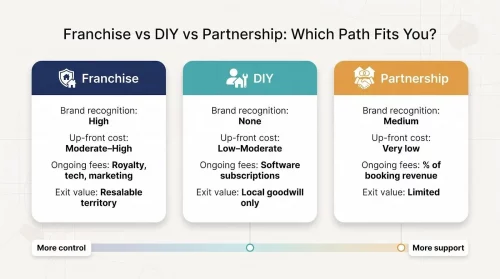 You buy territory rights, follow a proven playbook, and share each booking through royalties plus required tech and marketing fees.
- You assemble your own software stack, keep every dollar after expenses, and handle all owner acquisition and guest support.
- Firms such as Evolve or Houst handle marketing and pricing for roughly ten to fifteen percent of revenue while you manage cleaners and maintenance; you pay no franchise fee but rarely keep the reviews or guest data.
| Feature | Franchise | DIY | Partnership |
| Brand recognition | High | None | Medium |
| Up-front cost | Moderate to high | Low to moderate | Very low |
| Ongoing fees | Royalty, tech, marketing | Software subscriptions | Ten–fifteen percent of booking revenue |
| Lead generation | Shared with franchisor | Owner secures all leads | Mostly corporate |
| Control of OTA listings & reviews | Shared or negotiated | Full | Mostly corporate |
| Exit value | Resalable territory | Local goodwill only | Limited |
Use the grid as a compass, not a verdict. If you thrive on sales but avoid late-night guest texts, a franchise’s guardrails can justify the royalty.
Already managing twenty homes with a tech stack you trust? DIY may leave more net profit on the table. Seeking a side income with minimal risk? A partnership can work; just read the fine print on who owns the listing history before you agree.
The Costs Headline Investment Figures Often Leave Out
Startup ranges on a franchise flyer show only the check you write to open the doors. Real cash burn starts the day you sign the first homeowner and continues until every bed is booked. Below are the line items that can turn optimistic pro formas into red ink.
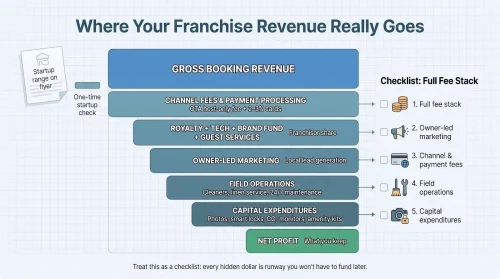
- Full fee stack. Royalty is just the opening toll. Most brands add a technology licence, a brand-fund levy, and sometimes a per-reservation guest-services charge. Combine them, divide by gross booking value, and the effective franchisor share often runs three to five percentage points above the headline royalty.
- Owner-led marketing. National SEO and PR help, but owners join only when you knock. Many FDDs mandate an initial marketing fund; if Item 7 lists less than $10,000 for owner leads, double-check the assumptions.
- Channel and payment fees. Airbnb’s host-only service fee of 15.5 percent for PMS-connected hosts (in place since October 27, 2025) flows straight through the booking engine. Credit-card processing adds another two to three percent. Build models on net revenue, not gross.
- Field operations. Linen service, deep cleans, and 24-hour maintenance exist even for home-based franchises, and labour rates climb every season. Ask current franchisees for cleaner pay, mileage, and call-out premiums in your market.
- Capital expenditures. Pro photography, smart locks, CO₂ monitors, and starter amenity kits add up quickly. Some franchisors negotiate bulk pricing; others leave you to retail. Get the procurement list early and price every SKU before finalising your budget.
Treat this list as a checklist: every hidden dollar you spot now is a month of cash runway you will not have to fund later.
How Many Properties Do You Need to Break Even?
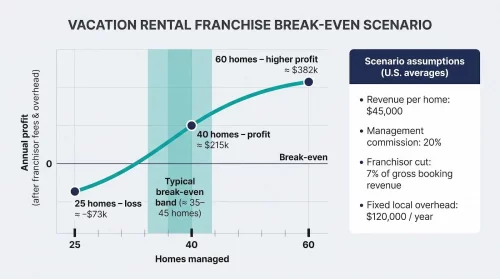
Break-even appears when management fees cover fixed costs so you can stop feeding the business with savings. Use the simple formula:
 Managed homes × annual booking revenue per home × your commission rate
= gross management revenue
From that pool subtract royalties, tech fees, payroll, marketing, and local overhead to find operating profit.
Illustrative U.S. assumptions (2026 industry averages):
- Annual booking revenue per home: $45,000
- Management commission: 20 percent
- Effective franchisor cut (royalty plus required fees): 7 percent of gross booking revenue
- Fixed local overhead: $120,000 per year (owner marketing, one employee, office, insurance)
Scenario Test
| Homes managed | Gross management revenue | Franchisor fees (7 percent) | Net before overhead | Result after $120,000 overhead |
| 25 | $225,000 | $15,750 | $209,250 | ($73,250) loss |
| 40 | $360,000 | $25,200 | $334,800 | $214,800 profit |
| 60 | $540,000 | $37,800 | $502,200 | $382,200 profit |
In many markets a franchise reaches break-even around 35–45 homes. Coastal areas with higher labour costs may need more; rural markets may need fewer.
Adjust the calculator with your local ADR, occupancy, wage rates, and franchisor fee schedule to find your true number.
2027 Shifts That Could Reorder the Leaderboard
Three outside forces could move a franchise up, or down, the rankings before the year is out.
- Casago-Vacasa integration. Casago completed its Vacasa acquisition on May 1, 2025, adding more than 40,000 managed homes. Bigger scale improves buying power and tech funding, but track two metrics: how many Vacasa offices convert to full franchises, and whether owner churn spikes during the hand-off.
- Airbnb host-only fee. Since October 27, 2025, PMS-connected hosts pay a 15.5 percent host-only service fee. Brands with net-rate pricing engines and clear owner communication gain an immediate edge; those focused only on gross revenue risk margin shock.
- Cost of capital. SkyRun’s published start-up range of $105,080–$153,980 now sits mid-pack. In a higher-rate climate, brands that lower upfront spend or reach break-even faster can attract investors who prefer leaner models.
A franchise ranked sixth today could climb to third by mastering net-rate pricing, trimming cash burn, or showing smooth post-merger execution, and the reverse is just as possible.
Brands Often Mistaken for Vacation-rental Franchises
A quick Google search for “vacation rental franchise” surfaces many companies that do not actually sell franchise rights. Use this checklist to separate true franchises from look-alikes.
- Charges owners ten to fifteen percent of booking revenue for marketing and reservations, while field work remains with the homeowner or a local partner. No protected territory, no FDD, no royalty; this is a partnership model.
- Houst and GuestReady. Hybrid programs in several countries that license software and brand assets and sometimes hold homeowner contracts. Revenue share yes; franchise disclosure laws no.
- TurnKey and Vacasa. TurnKey was absorbed by Vacasa in 2021, and Vacasa itself became part of Casago on May 1, 2025, so any “Vacasa franchise” article is out of date.
- Awning by RedAwning, Casai, and RedAwning. Provide management or distribution technology, not territory-based franchises.
- Real Property Management. A legitimate franchise, but it focuses on long-term residential property management, not specialist short-term rentals.
Rule of thumb: if there is no current Franchise Disclosure Document, no Item 19, and no map of available territories, you are not looking at a vacation-rental franchise.
Which Franchise Fits Which Type of Buyer?
Different operators need different playbooks. Use the guide below to jump straight to the brand that mirrors your goals, then confirm the details in the 2027 Franchise Disclosure Document before you sign.
SkyRun : balanced all-rounder
Ideal for hands-on owners who want national tech and moderate fees without giving up local autonomy (≈ 40 franchise markets).
Grand Welcome : sales-focused growth
Best for extroverts who enjoy pitching homeowners and who value a 24/7 guest-services center; tiered territories let you start small and expand.
iTrip : digital-native specialist
Suits home-office operators who prefer to outsource late-night guest messages while they focus on owner care and local partnerships.
Casago : scale upgrade for existing managers
Fits operators already handling about 30 homes who need enterprise-grade CRM, revenue tools, and bulk purchasing; verify post-Vacasa integration progress first.
Pass the Keys : UK start-up play
Designed for entrepreneurs in regulated British cities who want a nationally recognised badge and AI-assisted tech without seven-figure capital.
Property Management Inc. : diversification hedge
Appeals to owners who fear local STR restrictions and want additional pillars such as long-term, commercial, and association management within the same franchise.
Direct Booker : international watch list
A match for operators in Croatia, Spain, the Adriatic islands, or Latin America who value Booker Tools’ channel connectivity more than a heavyweight consumer brand; proceed only once 2027 fees are published.
Vacation-rental Franchise Due-diligence Checklist
A glossy presentation is not proof. Work through each step below before you sign.
Documents and Data
- Request the full 2027 FDD and read Items 5, 6, 7, 17, 19, and 20 line by line. Flag any “N/P” gaps.
- Confirm the royalty base: does it apply to gross booking revenue or only the commission you keep?
- Review Item 20 for openings, closures, transfers, and reacquisitions; net growth matters more than headline growth.
People and Portfolios
- Call at least eight current franchisees plus two who have left. Record unit counts at months 12, 24, and 36 and note why owners quit.
- Pull three homeowner contracts. Check termination notice, assignment limits, and who owns guest reviews.
Regulation and Licensing
- Verify state or local licensing, because some jurisdictions treat key exchange as brokerage activity.
- Price your territory’s permit inventory and political climate; a sudden cap can erase forecasts overnight.
Operations and Technology
- Ask for a live pricing or booking update during discovery day instead of relying on a static demo.
- Stress-test cash flow: model a 20 percent booking decline and a 10 percent wage increase.
- Audit the tech fee stack (software, guest services, payment processing) to find the true franchisor cut.
Exit Planning
- Confirm non-compete radius, transfer fees, and whether you keep the homeowner list if you leave the brand.
Conclusion
Check every box before discovery day ends; the answers you gather now can save years of costly surprises.