


























The UK State Pension has not been cut in 2026. From 6 April 2026, the full new State Pension increased by 4.8% from £230.25 to £241.30 a week. The full basic State Pension also rose from £176.45 to £184.90 a week.
However, the advertised full rate is not automatically paid to everyone. National Insurance gaps, previous contracting-out arrangements, transitional calculations and frozen overseas pensions can leave some people receiving less.
The State Pension age is also gradually rising from 66 to 67 between 2026 and 2028. This delays access for people born during the affected period but does not reduce the weekly pension itself.
Tax is another concern because the full new State Pension is now worth £12,547.60 over 52 weeks, only £22.40 below the standard £12,570 Personal Allowance. Therefore, even a small amount of other taxable income can produce a tax bill.
Last Updated: 29.08.2026
Why Do Some Pensioners Receive Less Than the Full State Pension?
The full new State Pension is a maximum rate rather than a guaranteed payment. Each person’s entitlement is calculated using their National Insurance record and any transitional arrangements that apply.
Receiving less than £241.30 a week does not necessarily mean that the government has cut the pension. It normally means the individual has not built up entitlement to the maximum amount.
 Contracting Out And Its Long-Term Impact
Before April 2016, employees enrolled in certain workplaces or private pensions could be contracted out of the Additional State Pension.
They or their employers generally paid lower National Insurance contributions because their pension scheme was expected to provide part of their retirement income.
Contracting out ended when the new State Pension was introduced in April 2016, but it can still affect current calculations. Someone who was contracted out may have a lower starting amount and could need more than 35 qualifying years to receive the full new State Pension.
Additional qualifying years built up after April 2016 can increase the starting amount. The increase continues until the person reaches the full rate or State Pension age.
National Insurance Gaps And Qualifying Years
People normally need at least 10 qualifying years on their National Insurance record to receive any new State Pension.
The commonly quoted 35-year requirement applies mainly to someone whose National Insurance record began after 5 April 2016. People with earlier contributions are covered by transitional rules and may need fewer or more than 35 years.
National Insurance gaps can result from:
- Working Without Earning Enough To Pay National Insurance
- Living Or Working Abroad
- Being Unemployed Without Receiving Eligible Benefits
- Taking Time Away From Work Without Receiving NI Credits
- Missing Credits While Caring For Children Or Relatives
- Self-Employment Records Not Being Correctly Updated
Some gaps may already be covered by National Insurance credits. Checking the record before paying voluntary contributions can prevent someone from buying a year that does not increase their pension.
State Pension Changes For 2026 And 2027
The most important confirmed change is the 4.8% increase introduced in April 2026. The amount payable from April 2027 has not yet been confirmed.
UK State Pension Comparison: 2025 vs 2026 vs 2027
| State Pension Detail | 2025–26 | 2026–27 | 2027–28 |
| Full New State Pension | £230.25 A Week | £241.30 A Week | Not Yet Confirmed |
| Annual New State Pension | £11,973.00 | £12,547.60 | Not Yet Confirmed |
| Full Basic State Pension | £176.45 A Week | £184.90 A Week | Not Yet Confirmed |
| Annual Basic State Pension | £9,175.40 | £9,614.80 | Not Yet Confirmed |
| Triple Lock Increase | 4.1% | 4.8% | Not Yet Confirmed |
| Standard Personal Allowance | £12,570 | £12,570 | Currently Scheduled At £12,570 |
| State Pension Age | 66 | Transition From 66 To 67 | Transition Continues |
| Status | Previous Rate | Confirmed Current Rate | Awaiting Autumn 2026 Announcement |
The 2027–28 amounts should not be presented as confirmed until the government completes the annual uprating process.
Confirmed State Pension Changes For 2026–27
The 4.8% increase for 2026–27 was determined by average earnings growth, which was higher than the relevant inflation figure and the Triple Lock minimum of 2.5%.
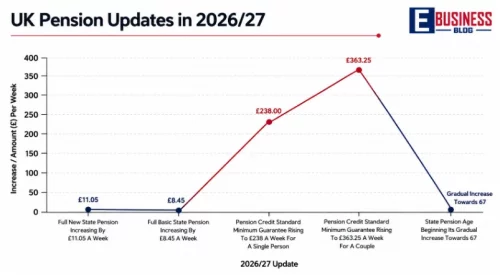 The changes included:
- Full New State Pension Increasing By £11.05 A Week
- Full Basic State Pension Increasing By £8.45 A Week
- Pension Credit Standard Minimum Guarantee Rising To £238 A Week For A Single Person
- Pension Credit Standard Minimum Guarantee Rising To £363.25 A Week For A Couple
- State Pension Age Beginning Its Gradual Increase Towards 67
Protected payments above the full new State Pension and some Additional State Pension components may rise at a different rate because they can be linked to inflation rather than the complete Triple Lock.
Upcoming 2027–28 Rate Announcement
The 2027–28 State Pension rate is expected to be confirmed later in autumn 2026.
The Triple Lock calculation will compare:
- Average Earnings Growth
- September Consumer Prices Index Inflation
- The Minimum 2.5% Increase
Whichever figure is highest will normally determine the increase applied to the full basic and new State Pensions from April 2027.
Until the government publishes the final uprating decision, estimates for £250 or other possible weekly amounts should be described as projections rather than guaranteed payments.
Ongoing Schemes And Reviews
Several policies and support arrangements remain relevant during 2026–27:
- Triple Lock Protection Continues For The Current Parliament
- Pension Credit Remains Available To Eligible Low-Income Pensioners
- National Insurance Credits Continue To Protect Qualifying Years
- Voluntary NI Contributions Can Fill Certain Eligible Gaps
- The Third State Pension Age Review Remains Ongoing
- State Pension Forecasts Remain Available Before Retirement
Pension Credit is separate from the State Pension. Eligibility depends on income and circumstances, and a successful claim can also provide access to other forms of support.
Is The State Pension Age Rising In 2026 And Beyond?
The State Pension age is no longer simply 66 for everyone approaching retirement. The phased increase to 67 began in 2026 and will continue into 2028.
People born between 6 April 1960 and 5 March 1961 will reach State Pension age between 66 years and one month and 66 years and 11 months.
| Date Of Birth | State Pension Age |
| Before 6 April 1960 | 66 |
| 6 April 1960 To 5 March 1961 | Between 66 Years And One Month And 66 Years And 11 Months |
| 6 March 1961 To 5 April 1977 | 67 |
| Later Legislated Increase | 68 Between 2044 And 2046 |
The third State Pension age review is considering life expectancy, affordability and the long-term sustainability of the system. However, an earlier increase to 68 has not been confirmed.
A rising State Pension age can feel like a financial reduction because affected people must wait longer to claim. Legally, though, it is a delay in eligibility rather than a cut to the weekly rate.
Has The UK State Pension Actually Been Cut In 2026?
There has been no nationwide State Pension rate cut in 2026. Both the new and basic State Pensions increased in April.
An individual payment may still be lower than expected because of:
- Missing National Insurance Years
- Previous Contracting-Out Arrangements
- Transitional State Pension Calculations
- Deductions Caused By An Overpayment
- A Pension Being Frozen While Living Abroad
- Tax On Total Retirement Income
- Starting With Less Than The Full Entitlement
Some people may receive more than the standard full new State Pension because they have a protected payment linked to entitlement built up under the previous system.
How Does Income Tax Affect State Pension Payments?
The State Pension is taxable income, but it is paid without tax being deducted directly.
The full new State Pension provides £12,547.60 over 52 weeks in 2026–27. This is only £22.40 below the standard Personal Allowance of £12,570.
As a result, income from any of the following sources may create a tax liability:
- Workplace Or Private Pensions
- Employment Or Self-Employment
- Taxable Savings Interest
- Property Income
- Certain Investment Income
- A Protected State Pension Payment Above The Full Rate
HMRC may collect the tax through a private pension or employment tax code. Where this is not possible, it may issue a Simple Assessment bill.
Pensioners receiving only the standard full new State Pension will generally remain below the Personal Allowance in 2026–27. Those with protected payments or other taxable income may exceed it.
What To Do If A State Pension Is Lower Than Expected?
A lower payment should be checked rather than automatically treated as a government cut. The State Pension award letter and National Insurance record should show how the amount was calculated.
Check The State Pension Forecast.
A State Pension forecast can show:
- The Estimated Weekly Payment
- The Date State Pension Age Will Be Reached
- Whether Further Qualifying Years Could Increase The Amount
- Whether The Maximum Rate Has Already Been Reached
The forecast is particularly useful before paying voluntary contributions because not every missing year increases entitlement.
Review The National Insurance Record.
The National Insurance record should be checked for missing contributions and credits. People may receive credits while claiming certain benefits, caring for another person or receiving Child Benefit for a child under 12.
If an eligible credit is missing, correcting the record may be more appropriate than buying voluntary contributions.
Fill Eligible Gaps With Voluntary Contributions
The Class 3 voluntary National Insurance rate is £18.40 a week in 2026–27, equal to £956.80 for a complete year at the current rate.
An additional qualifying year can add up to approximately £6.89 a week to the new State Pension. However, the actual increase depends on the person’s record.
Contributions can normally be paid for gaps within the previous six tax years. The temporary arrangement allowing people to fill gaps dating back to April 2006 ended on 5 April 2025.
Before paying, individuals should confirm:
- The Missing Year Is Eligible To Be Filled
- The Contribution Will Increase Their Pension
- They Have Not Already Reached The Maximum
- Paying Will Not Unnecessarily Reduce Means-Tested Support
- The Cost Is Appropriate For Their Circumstances
State Pension Payments When Living Abroad
The UK State Pension can usually be paid abroad, but annual increases are not available in every country.
Yearly uprating generally continues for pensioners living in the European Economic Area, Switzerland and countries covered by an agreement that provides pension increases.
Some countries with social security agreements, including Canada and New Zealand, do not receive annual UK State Pension increases.
A frozen pension returns to the current rate if the person later moves permanently to the UK or another country where annual increases are payable.
Conclusion
The UK State Pension has not been cut in 2026. The full new State Pension increased to £241.30 a week, while the full basic rate rose to £184.90.
Lower individual payments are usually caused by National Insurance records, contracting out, transitional rules or overseas uprating restrictions. The phased rise in State Pension age can also delay when payments begin.
The 2027–28 rates have not yet been confirmed. UK Pensioners and people approaching retirement should rely on their personal forecast and wait for the official autumn 2026 uprating announcement before treating projected figures as final.
Frequently Asked Questions
Is The UK State Pension Being Cut In 2026?
No. The full new and basic State Pension rates both increased by 4.8% from April 2026.
What Is The Full New State Pension In 2026–27?
The full new State Pension is £241.30 a week, equivalent to £12,547.60 over 52 weeks.
Has The 2027–28 State Pension Rate Been Confirmed?
No. The final rate is expected to be announced in autumn 2026 after the relevant earnings and inflation figures are available.
Does Everyone Need Exactly 35 Qualifying Years?
No. Thirty-five years generally applies where the National Insurance record began after April 2016. Transitional cases can require a different number.
What Is The State Pension Age In 2026?
The phased increase from 66 to 67 is underway. The precise age depends on the individual’s full date of birth.
Will Pensioners Pay Tax On Their State Pension?
The State Pension is taxable, but tax is due only when total taxable income exceeds the applicable Personal Allowance.
Are Voluntary National Insurance Contributions Worth Paying?
They can be worthwhile when a missing year increases entitlement, but not every gap does. The State Pension forecast should be checked before paying.