

























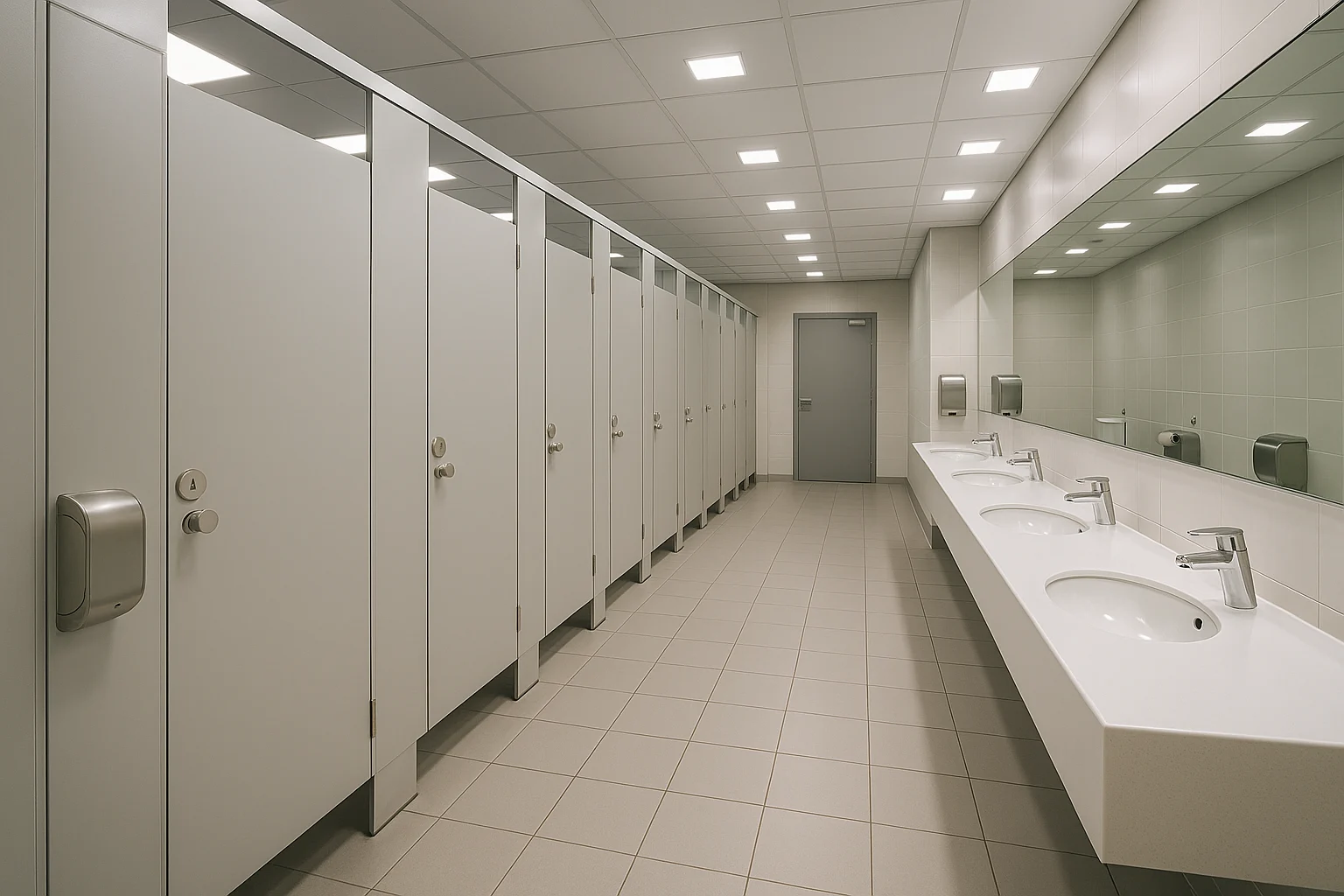
Providing adequate workplace toilets is a legal welfare requirement across the UK, but the precise legal framework differs between Great Britain and Northern Ireland.
In England, Scotland and Wales, most workplaces are covered by the Workplace (Health, Safety and Welfare) Regulations 1992, while Northern Ireland has its own Workplace (Health, Safety and Welfare) Regulations (Northern Ireland) 1993.
Employers must provide suitable and sufficient toilets and washing facilities, taking account of how many people are at work, accessibility, privacy, cleanliness and the type of work being carried out.
The standard HSE toilet ratios remain current in 2026, so employers should focus on meeting these requirements rather than assuming the older date of the legislation makes the rules outdated.
What Are the Legal Requirements for Toilets in the Workplace in the UK?

In England, Scotland and Wales, the main requirements for ordinary workplaces come from the Workplace (Health, Safety and Welfare) Regulations 1992.
Regulation 20 requires suitable and sufficient sanitary conveniences at readily accessible locations, while Regulation 21 covers washing facilities.
Northern Ireland operates under the separate Workplace (Health, Safety and Welfare) Regulations (Northern Ireland) 1993.
HSENI has approved the HSE’s L24 workplace welfare Approved Code of Practice for use alongside the Northern Ireland regulations, meaning the practical guidance remains closely aligned.
Employers should provide enough toilets and washbasins for the maximum number of people likely to be at work at one time.
Facilities should be accessible, clean, adequately ventilated and lit, and provide appropriate privacy. Workers with disabilities must also be considered, with reasonable adjustments made where required.
Toilets must be:
- Easily accessible from any part of the workplace
- Available in adequate numbers to prevent queuing or delays
- Located in a way that ensures privacy, especially where shared or mixed-gender use is involved
Additionally, toilets must be available for any employee, including those with specific needs or disabilities.
Reasonable adjustments, such as wider cubicles or grab rails, should be implemented where required to support workers with conditions like mobility issues or long-term illnesses.
Facilities must remain hygienic, fully functional, and be kept in a clean state, with employers bearing full responsibility for regular inspections, cleaning routines, and maintenance.
How Many Toilets Should Be Provided Per Number of Employees?
The minimum number of toilets and washbasins in a workplace is based on the total number of people expected to be on-site at any given time. These numbers are designed to prevent overuse and maintain hygiene standards.
The Health and Safety Executive (HSE) sets out specific ratios depending on whether the toilets are for mixed use (or women only), or used only by men.
Toilet and Washbasin Requirements for Mixed Use (or Women Only)
| Number of Employees | Minimum Number of Toilets | Minimum Number of Washbasins |
| 1 to 5 | 1 | 1 |
| 6 to 25 | 2 | 2 |
| 26 to 50 | 3 | 3 |
| 51 to 75 | 4 | 4 |
| 76 to 100 | 5 | 5 |
For mixed-use or women-only facilities, HSE’s Approved Code of Practice states that one additional toilet and one additional washbasin should be provided for every 25 people, or part of 25, above 100.
For toilets used only by men, one additional toilet cubicle for every 50 men, or part of 50, above 100 is considered sufficient, provided at least an equal number of additional urinals is also provided.
Employers should calculate requirements using the maximum number of people likely to be at work at any one time.
Toilet and Urinal Requirements for Men Only
| Number of Male Employees | Minimum Number of Toilets | Minimum Number of Urinals |
| 1 to 15 | 1 | 1 |
| 16 to 30 | 2 | 1 |
| 31 to 45 | 2 | 2 |
| 46 to 60 | 3 | 2 |
| 61 to 75 | 3 | 3 |
| 76 to 90 | 4 | 3 |
| 91 to 100 | 4 | 4 |
Separate facilities for men and women are generally required unless the toilet rooms are designed for individual use and are lockable from the inside.
What Does the Health and Safety Executive (HSE) Say About Toilet Facilities?
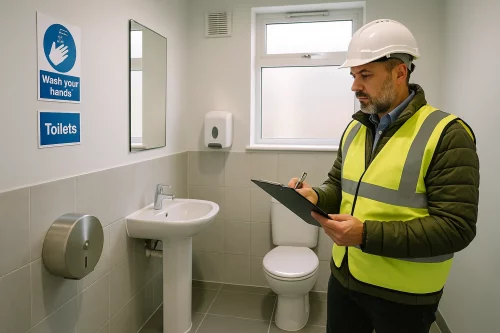
The Health and Safety Executive (HSE) sets out clear expectations for the provision, maintenance, and accessibility of workplace toilets across the UK.
These expectations are laid out in the Workplace (Health, Safety and Welfare) Regulations 1992, which outline what employers must do to safeguard employee welfare.
Basic Toilet Facility Requirements
Every workplace must provide:
- Clean and working toilets that are readily accessible
- Washbasins with running hot and cold (or warm) water
- Soap or a suitable cleaning agent
- A means for drying hands, such as paper towels or electric hand dryers
- Adequate lighting and ventilation to ensure comfort and hygiene
Toilets should also be located in a convenient place relative to workstations and should be usable at all times during working hours.
Requirements for Privacy and Gender Separation
Workplace toilets must be designed to protect user privacy.
Where facilities are shared between men and women, each cubicle must be:
- Self-contained
- Lockable from the inside
- Equipped to provide full privacy
If this standard of privacy cannot be guaranteed, employers are legally obliged to provide separate male and female toilet facilities.
Support for Employees With Disabilities
Employers must make sure welfare facilities are suitable for workers with disabilities and make reasonable adjustments where a disabled worker would otherwise be placed at a substantial disadvantage.
The adjustment required will depend on the individual and the physical features of the workplace. This could involve changing access arrangements or adapting toilet and washing facilities. There is not one identical list of toilet adaptations that every workplace must install regardless of circumstances.
Employers should assess actual accessibility barriers and agree reasonable adjustments that allow disabled workers to use workplace facilities safely and with dignity.
Sanitary Disposal for Female Employees
Workplace facilities used by female workers must provide a suitable means of disposing of sanitary dressings.
Employers should ensure the disposal arrangements are hygienic, readily available and regularly maintained as part of normal washroom cleaning and waste-management procedures.
Are There Different Toilet Requirements for Men and Women at Work?
Yes, the law recognises that toilet needs vary based on gender, which is why there are different provisions for men and women.
For female employees, each toilet facility must also offer a suitable method for the disposal of sanitary dressings. Sanitary bins must be provided in female or gender-neutral toilets and emptied regularly to maintain hygiene.
For shared facilities, employers must ensure each cubicle is fully self-contained, private, and fitted with a lockable door. Where this is not possible, separate male and female toilets must be made available.
In workplaces with a large gender-diverse workforce or where unisex toilets are introduced, all employees must have access to a toilet that offers privacy, dignity, and equal standards of hygiene.
What Are the Minimum Standards for Hygiene and Sanitation in Workplace Toilets?
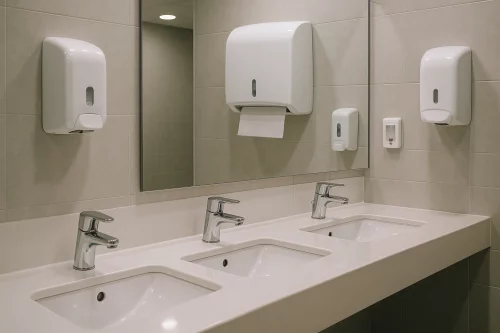
All toilet and washing areas should be maintained in a clean and orderly condition. The frequency of cleaning should reflect the number of users and the nature of the work carried out.
In high-traffic environments such as warehouses or factories, more frequent checks and cleaning cycles are necessary.
Essential hygiene requirements include:
- Regular disinfection of toilet seats, handles, and basins
- Cleaning schedules logged and displayed visibly
- Proper waste disposal systems, including bins for general and sanitary waste
- Ventilation systems to manage moisture and reduce the build-up of bacteria
Handwashing is a critical component of workplace hygiene. Therefore, all washbasins should have running water that’s warm or a mix of hot and cold, along with sufficient soap and drying options.
How Should Employers Maintain Toilet Facilities in the Workplace?
Toilet facilities are only effective if they are clean, functional, and consistently maintained. Employers have an ongoing responsibility to ensure all toilets and washbasins remain in good working order and meet hygiene standards.
Routine Cleaning and Inspection Schedules
Workplace toilets must be cleaned frequently enough to ensure hygiene is maintained throughout the day.
The frequency of cleaning should depend on:
- The number of employees using the facility
- The nature of the work (e.g., office vs. industrial or construction environments)
- The rate of usage throughout the day
Cleaning logs or schedules are recommended for larger workplaces to ensure accountability and regular checks.
Refilling Consumables and Maintaining Supplies
Toilets and washrooms must always be stocked with:
- Toilet paper in every cubicle
- Soap or other suitable hand-cleaning agents
- Paper towels or functioning hand dryers
- Sanitary bins (where applicable)
A designated team or individual should be responsible for monitoring and restocking supplies daily.
Repair and Maintenance Responsibilities
Functional defects should be addressed promptly to avoid disruption.
Employers should:
- Respond quickly to reports of leaks, blockages, or faulty flushes
- Fix broken taps, locks, lighting, or ventilation fans
- Replace damaged tiles or fittings that may pose hygiene or safety risks
Having a planned preventative maintenance programme in place helps reduce downtime and ensures compliance with health and safety laws.
Providing Feedback Channels for Staff
Employers should create a simple and accessible system for employees to:
- Report maintenance issues anonymously or directly
- Request improvements or highlight hygiene concerns
- Suggest additional facilities in high-demand areas
Encouraging staff feedback helps maintain a responsive and hygienic workplace environment.
Cleaning for High-Risk Work Environments
In settings where employees are exposed to dirt, hazardous materials, or chemicals (e.g., construction, manufacturing, or laboratories), toilet and washing facilities may require:
- More frequent cleaning intervals
- Showers or additional handwashing stations
- Specific cleaning protocols for contamination control
In such cases, employers must provide additional welfare facilities beyond standard requirements to reduce risks of cross-contamination and protect employee health.
Do Remote, Temporary, or Mobile Worksites Have Different Toilet Regulations?
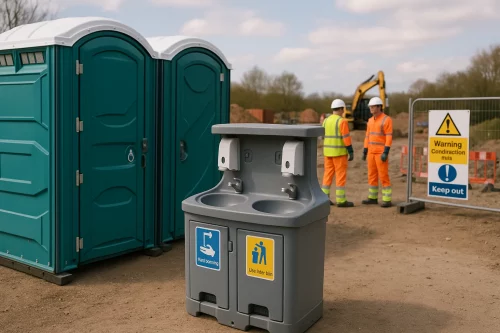
Yes. Temporary and remote workplaces still require suitable toilet and washing facilities. Where permanent plumbing is not reasonably practicable, employers can use portable facilities, chemical toilets and appropriate water containers.
Public toilets should normally be treated as a last resort rather than used simply because they are cheaper than providing workplace facilities.
Construction sites need particular care because the Workplace (Health, Safety and Welfare) Regulations 1992 do not generally apply to construction work on construction sites in Great Britain.
Construction welfare duties are instead covered by the Construction (Design and Management) Regulations 2015. Northern Ireland has separate Construction (Design and Management) Regulations (Northern Ireland) 2016.
HSE advises construction sites to provide flushing toilets wherever possible. Chemical toilets can be used where flushing facilities cannot reasonably be provided.
HSE also cites the BS 6465 recommendation of approximately one portable chemical toilet for every seven people working a 40-hour week when toilets are emptied weekly, although servicing frequency and site conditions must also be considered.
What Happens if Employers Don’t Provide Adequate Toilet Facilities?
Employers that fail to provide suitable and sufficient welfare facilities may face regulatory action. However, the relevant enforcing authority depends on the type of workplace.
In Great Britain, workplace health and safety enforcement is divided between the Health and Safety Executive and local authorities.
HSE generally covers workplaces such as factories, farms and construction sites, while local authorities commonly enforce health and safety requirements in offices, shops, hotels, restaurants and many leisure premises.
Northern Ireland has a similar division between HSENI and local district councils. HSENI covers areas including factories, building sites and farms, while district councils cover workplaces including offices, shops, restaurants, hotels and many privately operated leisure businesses.
Where legal requirements are breached, enforcing authorities can investigate and use appropriate enforcement measures, including notices and prosecution in serious cases.
Inadequate toilet facilities can also:
- Lead to increased sick leave due to poor hygiene
- Cause discomfort and dissatisfaction among staff
- Create grounds for employee complaints and legal claims
- Damage a company’s reputation, especially during audits or inspections
Meeting HSE toilet regulations is a core responsibility of any employer. Beyond compliance, it plays a critical role in promoting employee welfare and productivity.
Conclusion
Workplace toilet requirements have not been replaced by a new set of “2026 toilet laws”. The established welfare rules remain important, including the HSE guidance on minimum toilet and washbasin numbers.
Employers should calculate facilities according to the maximum number of people likely to be at work, maintain appropriate standards of cleanliness and privacy, make reasonable adjustments for disabled workers and apply the correct rules for temporary or construction sites.
Businesses operating across the UK should also remember that Great Britain and Northern Ireland have separate workplace welfare legislation and enforcement arrangements.
Regularly reviewing facilities against current HSE or HSENI guidance is the best way to maintain compliance and provide workers with safe, hygienic and dignified facilities.
Frequently Asked Questions
1. How Many Toilets Are Required for 1 to 5 Employees?
For mixed-use or women-only facilities, HSE guidance specifies at least one toilet and one washbasin for 1 to 5 people at work.
2. How Many Toilets Are Needed for More Than 100 Employees?
For mixed-use or women-only facilities, add one toilet and one washbasin for every additional 25 people, or part of 25, above 100.
3. Are Unisex Toilets Allowed in UK Workplaces?
Yes. In Great Britain, separate male and female facilities are not required where each toilet is in a separate room that can be locked from the inside.
4. How Often Must Workplace Toilets Be Cleaned?
There is no universal rule requiring a specific number of cleans per day. Facilities must be kept clean, with cleaning frequency based on usage, workplace conditions and the type of work carried out.
5. Do Employers Have to Provide Accessible Toilets?
Employers must provide suitable welfare facilities for disabled workers and make reasonable adjustments where required. The exact adjustments depend on individual needs and workplace barriers.
6. Can Construction Sites Use Portable Chemical Toilets?
Yes, where suitable flushing toilets cannot reasonably be provided. HSE advises that flushing facilities should be used wherever possible, with chemical toilets available as an alternative where necessary.
7. Who Enforces Workplace Toilet Regulations?
In Great Britain, enforcement is divided between HSE and local authorities according to the workplace’s main activity. In Northern Ireland, responsibility is shared between HSENI and district councils.