

























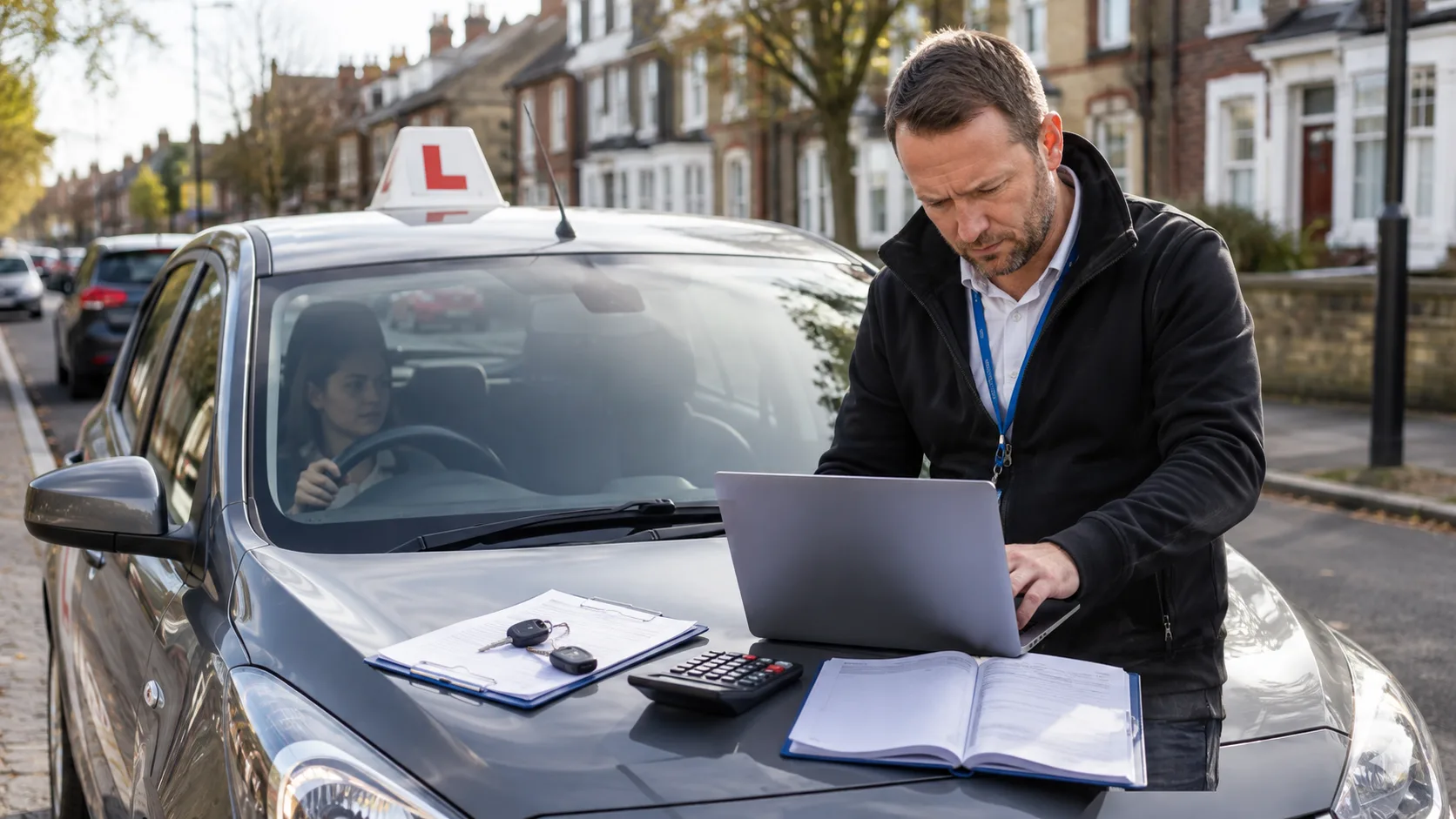
Driving instructor insurance in the UK can typically cost around £800 to £2,500+ per year in 2026, although there is no official national average specifically for instructors.
Experienced Approved Driving Instructors (ADIs) can sometimes obtain policies towards the lower end of the range, while Potential Driving Instructors (PDIs), higher-risk vehicles and instructors working in busy urban areas may pay considerably more.
| Factor | Typical Position in 2026 |
| Indicative Annual Cost | Around £800 to £2,500+ |
| Qualified ADI | Often around £800 to £1,400 |
| Trainee PDI | Often around £1,300 to £2,100 |
| Legal Minimum | Third-party motor insurance |
| Tuition Cover | Must cover paid driving instruction |
| Main Cost Factors | Vehicle, postcode, experience, mileage and claims |
| Useful Extras | Dual-control replacement car, breakdown and liability cover |
These figures should only be treated as budgeting estimates. Every insurer assesses risk differently, meaning two instructors using similar cars can receive very different quotations.
Last Updated: 26.08.2026
How Much Does Driving Instructor Insurance Cost in the UK in 2026?
Driving instructor insurance usually costs substantially more than ordinary private car insurance because the vehicle is being used commercially and is regularly driven by inexperienced learners.
A qualified ADI with several years of experience, a clean claims record and a relatively inexpensive tuition vehicle may receive quotes towards the lower end of the market.
A newly qualified instructor or PDI may face a higher premium because the insurer has less professional driving-instruction history on which to assess the risk.
Typical 2026 estimates can be summarised as follows:
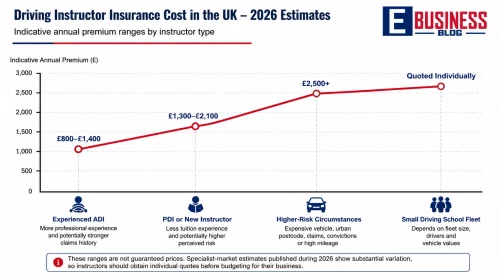
| Instructor Type | Indicative Annual Premium | Why Prices Differ |
| Experienced ADI | £800–£1,400 | More professional experience and potentially stronger claims history |
| PDI or New Instructor | £1,300–£2,100 | Less tuition experience and potentially higher perceived risk |
| Higher-Risk Circumstances | £2,500+ | Expensive vehicle, urban postcode, claims, convictions or high mileage |
| Small Driving School Fleet | Quoted Individually | Depends on fleet size, drivers and vehicle values |
These ranges are not guaranteed prices. Specialist-market estimates published during 2026 show substantial variation, so instructors should obtain individual quotes before budgeting for their business.
What Factors Affect Driving Instructor Insurance Costs?
An insurer does not calculate a driving instructor premium from qualification status alone. It considers the overall probability and potential cost of a claim.
ADI Or PDI Status
Fully qualified ADIs will often have more professional tuition experience than PDIs. This can work in their favour when premiums are calculated.
A PDI should tell the insurer that they are teaching under a trainee licence. Cover designed only for a fully qualified ADI may not automatically be appropriate.
Vehicle Type And Value
Higher-value cars can cost more to repair or replace. Engine size, performance, transmission type, safety technology and the cost of replacement parts may all influence the premium.
Modern cars can also contain expensive cameras, sensors and electronic systems. Even relatively minor collisions can therefore result in substantial repair bills.
Annual Mileage
Driving instructors frequently cover considerably more mileage than private motorists. Higher annual mileage increases time spent on the road and can increase exposure to accidents.
Instructors should provide an accurate mileage estimate rather than intentionally choosing a lower figure to reduce the premium.
Location
Where an instructor operates also matters. Busy urban roads, congestion, accident frequency, theft risk and local claims statistics can affect how an insurer calculates risk.
An instructor working primarily in central London, Birmingham or Manchester may therefore receive a different quote from someone operating mainly in a lower-traffic rural area.
Driving And Claims History
Previous accidents, insurance claims, penalty points and driving convictions can all affect premiums.
A strong no-claims history can help, although the discount available varies between insurers.
Policy Excess
Choosing a larger voluntary excess can sometimes reduce the premium. However, instructors should make sure they could comfortably afford the total compulsory and voluntary excess if they needed to claim.
What Driving Instructor Insurance Is Legally Required in the UK?
All vehicles used on public roads must have at least third-party motor insurance. The official GOV.UK vehicle insurance rules explain the minimum requirements that apply to motorists.
For a driving instructor, simply having ordinary private motor insurance is not enough if that policy does not permit professional driving tuition.
The insurer needs to know that the vehicle is being used to teach learners for payment. The policy should therefore cover the vehicle’s actual business use, including learners driving it during lessons where applicable.
Third-party insurance covers eligible injury and property damage suffered by other people when the insured driver is responsible. It does not normally pay for damage to the instructor’s own vehicle following an at-fault collision.
Importantly, third-party cover should not automatically be assumed to be the cheapest option. Insurance pricing is based on risk, and a comprehensive quote can sometimes cost less despite offering wider protection.
What Types of Driving Instructor Insurance Cover Are Available?
Driving instructor insurance can contain several types of protection. Some form part of the motor policy while others may be optional business insurance.
Comprehensive Driving Instructor Insurance
Comprehensive cover generally provides the widest level of motor protection.
Depending on the policy, it can include:
- Accidental Damage to the instructor’s vehicle
- Third-Party Damage involving other vehicles or property
- Theft And Fire Cover for the tuition vehicle
- Learner Driver Cover during insured tuition
- Dual-Control Vehicle Cover where declared and accepted by the insurer
Exact conditions differ between insurers, so instructors should check the policy wording rather than relying only on the word “comprehensive”.
Third-Party, Fire And Theft
This provides third-party protection along with cover if the insured vehicle is stolen or damaged by fire.
It normally does not cover the instructor’s own vehicle when they or their learner is responsible for an accident.
Third-Party Only
Third-party insurance is the minimum level of motor cover legally permitted.
It generally covers:
- Third-Party Injuries
- Damage To Other Vehicles
- Damage To Other People’s Property
It does not usually pay to repair or replace the instructor’s own vehicle following an at-fault accident.
Public Liability Insurance
Public liability insurance can provide additional business protection where a member of the public alleges that the instructor’s business activities caused injury or property damage.
It is generally not a statutory requirement for a self-employed sole-trader driving instructor, although instructors may choose to include it as part of a broader insurance package.
Professional Indemnity Insurance
Professional indemnity cover can protect against certain claims relating to professional services, advice or alleged negligence.
Whether it is appropriate will depend on how the instructor operates and what protection is already contained within the specialist policy.
Employers’ Liability Insurance
Driving schools employing staff need to pay particular attention to employers’ liability requirements.
The HSE employers liability guidance states that most employers are legally required to insure against liability for injury or disease suffered by employees because of their work.
A self-employed instructor working alone will not normally need employers’ liability insurance simply because they are self-employed.
Breakdown And Dual-Control Replacement Cover
For a professional instructor, losing access to the tuition vehicle can also mean losing income.
Specialist policies may therefore offer:
- Roadside Assistance
- Vehicle Recovery
- Dual-Control Replacement Cars
- Onward Travel
- Replacement Vehicle Cover Following An Insured Claim
Check whether a dual-control replacement vehicle is guaranteed or simply provided when one is available.
ADI Vs PDI Insurance Costs in 2026
Qualification status remains one of the most important differences when arranging specialist driving instructor cover.
| Factor | ADI | PDI |
| Status | Fully qualified instructor | Trainee instructor |
| DVSA Badge | Green | Pink |
| Experience | Usually greater | Often more limited |
| Indicative Annual Cost | £800–£1,400 | £1,300–£2,100 |
| Tuition Cover Required | Yes | Yes |
| Specialist Policy | Required for tuition use | Required for tuition use |
Becoming an ADI does not guarantee that the premium will immediately fall. Insurers still consider the vehicle, claims history, postcode, age, mileage and other individual risk factors.
When moving from PDI to ADI status, instructors should inform their insurer rather than assuming that the existing policy automatically updates.
Recent Updates Affecting Driving Instructors in 2026
There has not been a new 2026 law changing the basic third-party motor insurance requirement specifically for driving instructors. However, several developments around the driving tuition sector and wider insurance market are worth noting.
From 31 March 2026, learner drivers became limited to two changes to a car driving test booking.
From 12 May 2026, learners became responsible for booking and managing their own tests, meaning driving instructors can no longer book, change or cancel tests for pupils. From 9 June 2026, learners were also restricted to moving a test to one of the three nearest test centres.
These changes do not directly alter an instructor’s insurance policy, but they affect how instructors organise lessons, test-day vehicle availability and pupil schedules.
There has also been movement in the wider motor insurance market.
The latest ABI motor insurance data showed that the average private motor premium was £560 in Q1 2026, only £1 higher than Q4 2025 and £20 lower than Q1 2025. At the same time, vehicle repair costs continued to rise.
Driving instructor policies are specialist commercial products, so this £560 figure should not be used as an average instructor premium. It does, however, show why instructors should not assume that every insurance price automatically increased between 2025 and 2026.
Driving Instructor Insurance in 2025 Vs 2026
The core insurance requirement has remained broadly consistent, but the market and operating environment have changed.
| Area | 2025 | 2026 |
| Legal Motor Minimum | Third-party cover | Third-party cover remains the minimum |
| Tuition Use | Specialist tuition use needed | Still essential |
| Instructor Premiums | Wide variation | Wide variation continues |
| Wider Motor Premium Market | Premiums had started easing from previous highs | Q1 2026 average private motor premium broadly stable year on year |
| Vehicle Repair Costs | High repair costs affected insurers | Repair costs remain a major pressure |
| Test Booking | Instructors could have greater involvement in managing pupil bookings | Learners must now book and manage their own tests |
| Policy Priorities | Price and basic cover | Price, downtime protection and replacement vehicle benefits remain important |
The key point is that 2026 is an update to the market rather than a complete reset of driving instructor insurance rules.
Instructors should therefore avoid renewing a policy simply because it was suitable in 2025. Vehicle values, mileage, business circumstances and insurer pricing can change from one renewal to the next.
Which Driving Instructor Insurance Providers Can You Compare in 2026?
The UK specialist market includes insurers and brokers offering cover for qualified instructors, trainees and driving schools.
Names operating in this market include:
- Adrian Flux
- Everywhen
- InstructorCover Plus
- C&A Mackie
- Other Specialist Motor Insurance Brokers
Towergate should no longer be presented as a separate current brand in an updated provider list because the business now operates under the Everywhen name.
Rather than declaring one company the “best”, compare what is actually included in each quotation.
Useful areas to check include:
- Learner Driver Cover
- PDI Or ADI Eligibility
- Policy Excess
- Dual-Control Replacement Vehicle
- Breakdown Protection
- Public Liability Cover
- Legal Expenses
- Claims Support
- Annual Mileage Limits
The lowest headline premium may not provide the best value if a claim leaves an instructor without a suitable tuition vehicle for several weeks.
How Can You Reduce Driving Instructor Insurance Costs?
There is no guaranteed method for securing a cheap premium, but instructors can take several sensible steps.
- Compare Specialist Quotes because insurers can assess the same instructor differently
- Maintain A Clean Driving Record to reduce avoidable risk factors
- Build A No-Claims History where the policy allows it
- Choose A Sensible Tuition Vehicle rather than an unnecessarily expensive or high-performance model
- Estimate Mileage Accurately because incorrect information can create problems when claiming
- Review Your Voluntary Excess while keeping it affordable
- Check Optional Extras and remove features that provide little value to your business
- Review Cover At Renewal instead of allowing the policy to continue without comparison
Instructors should compare the total protection provided rather than choosing purely on annual premium.
Monthly Vs Annual Driving Instructor Insurance Payments
Many insurers allow premiums to be paid annually or through monthly instalments.
Paying monthly can help cash flow, particularly for a new instructor facing training, vehicle and business setup costs at the same time. However, instalments may involve interest or credit charges.
For example, a £1,400 annual premium could cost more overall when spread across monthly payments if the insurer applies a finance charge.
Before choosing monthly payments, compare:
- Annual Premium
- Deposit Required
- Monthly Instalment
- Interest Rate
- Total Amount Payable
The total amount payable is more useful than comparing the monthly instalment alone.
Future Plans And What Driving Instructors Should Watch?
Driving instructors should expect further changes around training standards, test administration and digital services, although these should not be confused with confirmed changes to insurance law.
DVSA’s most recently published business plan stated that it wanted to review the ADI qualification process, improve instructor training, increase standards checks and make greater use of performance data. It also highlighted continued work to reduce backlogs in ADI Part 2 and Part 3 tests.
 As of August 2026, instructors should watch for official announcements rather than assuming that proposals will automatically become new requirements.
From an insurance perspective, several longer-term factors are also likely to remain important:
- Vehicle Repair Costs as modern cars use more cameras, sensors and electronic equipment
- Electric And Hybrid Tuition Cars, which may have different repair values and insurance risks
- Replacement Vehicle Availability, particularly where a suitable dual-control car is required
- Higher Annual Mileage as instructors spend substantially more time on the road than private motorists
- ADI Qualification Changes if future DVSA reforms alter training or assessment requirements
Any instructor changing vehicles, moving from PDI to ADI status or substantially changing how their business operates should check whether the insurer needs to be notified.
Conclusion
Driving instructor insurance in the UK can broadly cost around £800 to £2,500+ per year in 2026, but there is no official national premium that applies to every instructor.
ADI or PDI status, location, vehicle value, annual mileage, claims history and selected cover can all make a significant difference.
The legal minimum remains third-party motor insurance, but instructors must ensure that their policy actually covers the vehicle for paid driving tuition and learner-driver use.
The wider motor market has stabilised compared with some of the sharp premium increases seen previously, although high repair costs remain a concern.
For instructors, the strongest policy is therefore not automatically the cheapest one. Appropriate tuition cover, manageable excesses and protection against losing access to a dual-control vehicle can be just as important as the headline premium.
Frequently Asked Questions
Is Driving Instructor Insurance Legally Required in the UK?
Motor insurance is legally required, with third-party cover being the minimum. Instructors must also ensure that their policy allows the vehicle to be used for paid driving tuition.
How Much Does Driving Instructor Insurance Cost in 2026?
A reasonable indicative range is around £800 to £2,500+ annually, although individual quotes can fall outside this range depending on risk factors and cover.
Can I Use Normal Car Insurance for Driving Lessons?
A normal private policy should not be assumed to cover professional tuition. The insurer must know that the vehicle is being used for paid driving instruction and learner drivers.
Do PDIs Pay More for Insurance Than ADIs?
PDIs often receive higher quotes because they have less professional instruction experience. However, qualification status is only one of several factors insurers consider.
Is Public Liability Insurance Compulsory for Driving Instructors?
Public liability insurance is generally optional for a self-employed instructor, although it can provide useful business protection. Employers’ liability is normally required when a driving school has employees, subject to legal exemptions.
Does Driving Instructor Insurance Cover Dual-Control Cars?
Specialist policies can cover dual-control tuition vehicles, but instructors should declare modifications and check the policy terms. Replacement dual-control vehicle cover may be included or offered as an extra.
Is It Cheaper to Pay Driving Instructor Insurance Annually?
It can be. Monthly instalments may include interest or credit charges, so compare the total amount payable with the annual upfront premium before deciding.