























Small enterprises have long played an important role in the UK economy, creating jobs, serving communities and bringing new ideas to market.
Their future depends on how effectively they respond to changing customer expectations, technological developments and the practical demands of running a business.
In 2026, digital tax reporting, AI adoption, employment responsibilities and sustainability requirements are giving owners specific decisions to make. At the same time, e-commerce, flexible working and local partnerships continue to offer opportunities for growth.
Understanding these trends helps business owners choose improvements that suit their resources, protect cash flow and strengthen customer relationships. The aim is to build a business that can adapt while maintaining reliable everyday operations.
Last Updated: 01.09.2026
Why Trends Are Shaping Small Enterprises?
The future of small enterprises is being shaped by a combination of digital change, financial discipline and closer relationships with customers and employees.
Businesses can increasingly use technology to manage tasks that previously required substantial time or specialist support.
However, access to a tool does not automatically produce better results. A small retailer, independent consultancy and local trades business will each have different priorities, budgets and customer needs.
The most useful trends to assess include:
- Digital Operations: Connecting accounting, customer records and routine administration
- Sustainable Practices: Reducing waste and energy use while meeting relevant requirements
- Flexible Employment: Developing working arrangements that suit employees and business needs
- Online Sales: Connecting digital visibility with dependable fulfilment and customer service
- Accessible Finance: Comparing funding options against realistic repayment capacity
- Practical AI: Testing tasks where automation can deliver measurable improvements
Small businesses can act on these changes by reviewing their biggest operational problems first, then choosing improvements that address them directly.
How Is Digital Transformation Redefining Small Business Operations?
Digital transformation connects the information and processes a business uses every day. Cloud accounting, customer relationship management systems and booking software can make records easier to maintain and reduce duplicated work.
For some sole traders, digital record keeping has also become a tax reporting requirement.
Making Tax Digital Requirements From 2026 to 2028
HMRC’s Making Tax Digital for Income Tax rollout began on 6 April 2026 for sole traders and landlords whose combined qualifying income from self-employment and property exceeded £50,000 in 2024–25, unless an exemption applies.
Qualifying income is assessed before expenses. It is not the same as business profit.
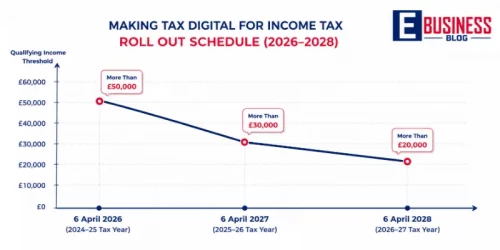
| Start Date | Qualifying Income Threshold | Relevant Tax Year |
| 6 April 2026 | More Than £50,000 | 2024–25 |
| 6 April 2027 | More Than £30,000 | 2025–26 |
| 6 April 2028 | More Than £20,000 | 2026–27 |
Affected individuals must use compatible software to maintain digital records, send quarterly updates and submit their tax return. This Income Tax rollout does not apply to every small business, and Making Tax Digital for VAT has separate requirements.
HMRC has also announced that, from September 2026, it will begin signing up individuals who should already be using the service but have not registered, based on its qualifying income records.
The Shift Towards Automation and Data-Driven Decisions
Automation can support invoice reminders, appointment confirmations and routine stock alerts. Connecting these processes reduces the need to enter the same information into several systems.
Data analytics helps owners turn sales records, customer activity and operating figures into useful decisions.
For example, reviewing product margins alongside sales volumes can reveal whether a popular item actually contributes enough profit.
The starting point can be a small set of reliable measures, such as repeat purchases, overdue invoices and average order value.
Benefits of Going Digital
- Less Administration: Connected systems can reduce repetitive manual tasks
- Clearer Records: Centralised information makes transactions and customer histories easier to review
- Faster Responses: Booking and communication tools help staff respond consistently
- Better Coordination: Shared information supports teams working across different locations
Software should fit the business’s workflow, with clear responsibility for access, record accuracy and backups.
Are Sustainability and Green Practices Becoming Essential for SMEs?
Sustainability affects purchasing, energy consumption, packaging and waste management. Small enterprises can make progress through manageable changes that reduce avoidable waste and improve how resources are used.
Why Green Business Matters?
Energy-efficient lighting, better stock control and reusable packaging can support lower operating costs, depending on the initial investment and how the business operates.
Measuring consumption before and after a change helps establish whether the expected savings are being achieved.
Environmental claims should describe specific actions that the business can support with evidence. Explaining a reduction in packaging is more useful than relying on a broad claim that a product is environmentally friendly.
Funding eligibility also needs careful checking. Older green grants, including the now-closed Green Homes Grant for homeowners and landlords in England, should not be treated as current support for business premises.
Owners should establish whether a scheme covers their location, property and proposed improvements before including it in a budget.
Simpler Recycling Requirements and the March 2027 Micro-Firm Deadline
In England, Simpler Recycling workplace requirements took effect on 31 March 2025, with a temporary exemption for businesses employing fewer than 10 full-time equivalent staff. These micro-firms have until 31 March 2027 to comply.
The requirements cover separating food waste, dry recyclable materials and residual waste before collection.
Paper and card normally need separate collection from other dry recyclables unless the collector has completed the required assessment allowing co-collection.
Employee numbers are counted across the whole business, rather than separately at each site. Owners should review collection contracts, bin arrangements and staff instructions ahead of the relevant deadline.
Businesses in Scotland, Wales and Northern Ireland should check their own national rules.
How Are Remote Work and Flexible Models Changing Small Business Structures?
Remote and hybrid arrangements have become established options for some businesses. Their suitability depends on the work involved, customer expectations and the level of coordination required.
Flexible Work as a Competitive Edge
Flexibility can include adjusted start times, part-time hours, compressed hours or a mixture of home and workplace attendance. This gives small employers several ways to accommodate staff needs.
A retailer may benefit from predictable shift choices, while a consultancy may be able to offer remote working. Clear availability, communication and service standards help make either arrangement workable.
Flexible Working Requests and Employer Responsibilities
In Great Britain, employees can make a statutory flexible working request from their first day of employment.
They can make two requests within 12 months, and employers normally have two months to decide, including any appeal, unless an extension is agreed.
Employers must handle requests reasonably and consult before rejecting them. A request can be refused for a permitted business reason, so the right to apply does not guarantee approval. Northern Ireland has different rules.
Statutory Sick Pay Changes From April 2026
From 6 April 2026, eligible employees across the UK became entitled to Statutory Sick Pay from their first full day of sickness absence. The lower earnings limit was also removed.
Payment is calculated at the lower of 80% of average weekly earnings or the statutory weekly rate.
Employers should ensure their payroll arrangements and absence policies reflect these changes, including the position of lower-paid and part-time staff.
Key Shifts in Workforce Dynamics
- Broader Recruitment: Suitable flexible arrangements can widen the pool of applicants
- Clearer Communication: Shared schedules and documented responsibilities help teams coordinate
- Skills Development: Training supports new software, changing tasks and consistent service
- Employee Support: Manageable workloads and fair processes help staff perform effectively
What Role Does E-Commerce Play in Expanding Small Business Reach?
E-commerce allows small businesses to sell beyond their immediate location. An independent retailer can serve customers nationally, while a service business can accept enquiries, bookings or payments outside normal opening hours.
However, greater reach also brings delivery costs, returns, platform fees and additional customer enquiries. These need to be included when assessing profitability.
Building Omnichannel Strategies
An omnichannel approach connects the ways customers interact with a business. Someone might discover a product through social media, check its availability online and collect it from a shop.
Consistent pricing, accurate stock information and clear collection instructions make that journey easier. A manageable starting point is to connect the channels customers already use most often.
Benefits of E-Commerce Growth
- Wider Reach: Products and services can reach customers beyond the local area
- Convenient Purchasing: Customers can browse and order when it suits them
- Better Sales Visibility: Order data can reveal patterns in demand and repeat purchases
- Flexible Expansion: Businesses can test selected products online before committing to larger premises
Growth becomes more sustainable when reliable delivery and customer support develop alongside sales.
How Are Small Enterprises Adapting to Changing Consumer Expectations?
Customers often judge a small business through everyday details, including how quickly it responds, whether prices are clear and how it handles a problem.
Technology can support these experiences, while attentive service gives customers a reason to return.
Personalisation and Human Touch
Personalisation can be straightforward. Remembering a regular customer’s preferences, providing relevant product advice or sending a useful follow-up can make an interaction more helpful.
Businesses should collect only the customer information they need and use it appropriately. Staff also need an easy way to take over when an automated response cannot resolve an enquiry.
Digital Engagement and Storytelling
Social media can show how products are made, introduce the people behind a service and explain improvements to the business. Specific, credible examples give customers more useful information than repeated promotional claims.
A consistent posting schedule and timely responses can support engagement without requiring a small team to maintain every available platform. The best channels are those that connect with the business’s actual audience.
What Funding and Financial Innovations Are Empowering SMEs?
Access to finance remains closely connected to business planning, a recurring theme in the entrepreneurship coverage on londonbusinessinsider.co.uk.
A clear plan helps owners explain what funding will achieve, how income will develop and which commitments the business can afford.
Fintech and Alternative Funding Options
Digital banking and cash flow tools can make it easier to track transactions and forecast upcoming payments. Crowdfunding, invoice finance and asset finance also offer different ways to fund particular needs.
Each option has trade-offs. Invoice finance can bring forward access to money tied up in unpaid invoices, while equity funding involves giving investors an ownership stake.
The appropriate choice depends on the business’s circumstances and the terms offered.
Current Start-Up Loan Terms and Eligibility
Government-backed Start Up Loans currently offer £500 to £25,000 at a fixed annual interest rate of 7.5%, with repayment over one to five years.
Applicants must be at least 18, live in the UK and have, or plan to start, a UK business that has been fully trading for less than five years. Other eligibility and assessment requirements apply.
The borrowing is an unsecured personal loan, and applicants must pass a credit check. Successful applicants can also receive up to 12 months of free mentoring.
 Growth Guarantee Scheme Support
The British Business Bank’s Growth Guarantee Scheme supports finance provided by participating lenders. An expansion announced in July 2026 is intended to unlock a further £6.5 billion of lending over four years.
The scheme provides a government-backed guarantee to the lender, while the borrower remains responsible for the full debt. Applications are subject to lender assessment, so government support does not mean automatic approval.
Assessing Affordability and Repayment Responsibilities
Before borrowing, owners should compare interest, fees, repayment schedules and any personal guarantees. Forecasts should allow for slower sales, late customer payments and seasonal changes.
A useful distinction is whether the money funds a specific improvement or covers a recurring operating shortfall. Understanding that purpose helps owners judge whether borrowing addresses the underlying business need.
How Important Are Collaboration and Local Networking in the SME Ecosystem?
Local relationships can support referrals, shared learning and a better understanding of customer needs.
Collaboration gives small enterprises opportunities to combine complementary skills without immediately increasing their own staffing or premises costs.
The Power of Networking
Chambers of commerce, coworking spaces, trade associations and local events can create opportunities to meet suppliers, customers and potential partners.
Useful networking depends on follow-through. A conversation becomes more valuable when both businesses understand what the other offers and identify a realistic opportunity to work together.
Collaborative Advantages
- Shared Expertise: Owners can exchange practical knowledge and learn from experience
- Customer Referrals: Complementary businesses can introduce relevant services to their customers
- Joint Promotion: Shared events and campaigns can help participating businesses reach new audiences
- Local Understanding: Regular contact can reveal changes in demand and service gaps
Partnerships work best when responsibilities, costs and customer expectations are agreed at the outset.
How Will AI and Automation Shape the Next Decade for Small Businesses?
AI is becoming more accessible through everyday software, but adoption and results vary. Its value depends on the task, the quality of the information available and the way staff use the output.
What the Latest ONS Data Shows About AI Adoption
ONS analysis published in July 2026 found that 28% of UK businesses with zero to nine employees reported using at least one AI technology.
Among businesses with 10 or more employees, reported adoption increased from around 12% in late 2023 to around 35% by June 2026.
These measures describe technology use, rather than proving that every adopting business achieved better financial results.
The analysis also identified costs and insufficient expertise as barriers, supporting the case for focused trials and staff training.
AI as a Growth Driver
Small businesses can test AI on clearly defined activities, such as drafting routine replies, preparing initial marketing copy or summarising non-sensitive documents. Human review remains necessary to check accuracy and suitability.
Demand forecasting and stock planning may also benefit from analytical tools when the business has sufficient reliable data. The expected improvement should be assessed against the cost of software, setup and ongoing checking.
Staff Training, Human Review and Measurable Results
A practical trial should establish what success looks like before the tool becomes part of everyday work.
- Choose a Task: Start with a repetitive activity that has a clear business purpose
- Set Information Rules: Decide what staff may enter into the tool
- Review Outputs: Check factual accuracy, tone and relevance before use
- Measure Results: Compare time saved, errors and service quality against the previous process
- Train Staff: Make responsibilities and escalation routes clear
This approach helps owners decide whether to expand, adjust or stop a particular use of AI.
Conclusion
The future of small enterprises in the UK will depend on practical decisions about technology, people, finance and customer service.
Digital tools, flexible working, e-commerce and collaboration can support growth when they address a clear business need.
For 2026 and beyond, owners should also review the reporting and employment requirements that apply to them, prepare for relevant recycling deadlines and assess funding against realistic repayment capacity.
Starting with manageable improvements, measuring the results and reviewing priorities regularly can help small businesses adapt while protecting the relationships and financial foundations that support them.
FAQs
What Should Small Enterprises Prioritise in 2026?
Priorities include cash flow, customer retention, relevant tax and employment requirements, and digital improvements that deliver measurable value.
Does Making Tax Digital Apply to Every Small Business?
No. The April 2026 Income Tax phase covers sole traders and landlords with qualifying income above £50,000 in 2024–25, subject to exemptions.
How Can Small Businesses Start Using AI?
Choose one routine task, set rules for information use and check output quality. Measure the time saved before extending it to other work.
When Must Micro-Businesses Follow Simpler Recycling Rules?
In England, businesses with fewer than 10 full-time equivalent employees have until 31 March 2027 to comply. Staff are counted across the whole business.
Can Employees Request Flexible Working From Their First Day?
Yes, in Great Britain, although approval is not automatic. Employers must handle requests reasonably, and Northern Ireland has different rules.
What Government-Backed Funding Can Small Businesses Explore?
Options include Start Up Loans and finance supported by the Growth Guarantee Scheme. Both involve repayable borrowing and eligibility checks.
What Changed About Statutory Sick Pay in April 2026?
Eligible employees became entitled from their first full day of sickness absence, and the lower earnings limit was removed. Payment is subject to the statutory calculation.