

























rk, package or technical standard with one identifiable official specification. The term is used in different ways online, which means developers should avoid assuming that it has a fixed architecture, official SDK or predetermined feature set.
For practical development purposes, OXZEP7 can instead be treated as a concept for a custom productivity and workflow platform combining task management, artificial intelligence, automation, collaboration and analytics.
Developing OXZEP7 software therefore starts with defining what the platform must achieve before selecting the architecture, AI components, integrations and deployment model.
This updated approach focuses on how such a platform could realistically be planned, built, tested, secured and scaled using modern software-development practices.
What Does OXZEP7 Software Mean In Practice?
OXZEP7 is best understood as a conceptual or custom software architecture rather than a confirmed off-the-shelf framework with a standard set of technical requirements.
Within a productivity-platform use case, an OXZEP7-style system could combine task planning, workflow automation, AI assistance, collaboration and performance insights within a single environment. However, those capabilities should be treated as design choices rather than built-in OXZEP7 features.
Before development begins, teams should define:
- Target users and the problems the platform must solve
- Core workflows and actions that need automation
- External systems, calendars, CRMs or document platforms that require integration
- Data-access and privacy requirements
- Performance, availability and scalability targets
- Which decisions AI may recommend and which actions require human approval
This requirements-first approach prevents development teams from building around assumptions that may not match the actual business problem.
What Are the Core Pillars of OXZEP7 Development?
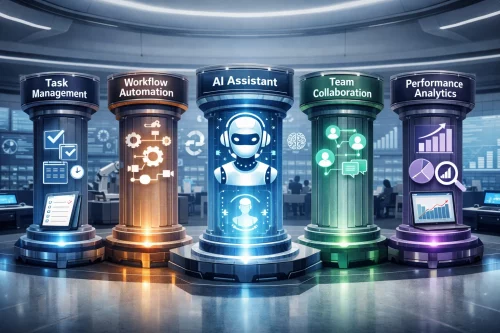
Developing OXZEP7 requires clear architectural and product decisions across multiple layers of user experience, intelligence and automation. The five major pillars form the foundation for delivering an intelligent productivity solution.
Intelligent Task and Priority Engine
The core of the system is the AI-enhanced task and priority engine that doesn’t just store tasks but evaluates and updates their relevance and order based on various dynamic inputs.
Features of this engine include:
- Dynamic prioritisation that calculates urgency using effort, deadlines, dependencies and user activity patterns
- Context-aware recommendations such as “Do this first” or “Defer until tomorrow”
- Goal-based task organisation where tasks are grouped by broader objectives instead of static lists
- Automatic task reordering when conflicts or overlaps are detected
The system learns over time by tracking:
- Completion habits across hours, days and weeks
- Frequency of task postponements or deferrals
- Times of day when user focus is at its highest
By adapting based on behavioural signals, the system reduces reliance on manual sorting and boosts productivity.
Workflow Automation Layer
OXZEP7 offers a native workflow builder that automates routine tasks across multiple platforms. This distinguishes it from traditional productivity tools that require third-party automation add-ons.
The automation builder is based on a trigger-action-condition logic where users can set simple or complex rules. For instance, when a task tagged “urgent” is delayed by more than 48 hours, the system can automatically escalate it or notify a team leader.
Automation examples include:
- Sending reminders when tasks remain incomplete past due date
- Automatically moving tasks to a “review” stage after document edits are complete
- Reassigning tasks if original owner is marked unavailable in the calendar
Cross-platform automation capabilities allow users to connect workflows across emails, calendars, CRMs and document tools. This layer creates seamless task flows without needing manual status updates.
AI Productivity Assistant
A modern OXZEP7 productivity assistant should do more than generate responses from user history. It should work with authorised task, calendar, project and document data while respecting the permissions already applied to those sources.
Useful capabilities could include:
- Generating daily plans from deadlines, dependencies and calendar availability
- Summarising meetings and extracting proposed actions
- Retrieving relevant information from approved workspace data
- Recommending task priorities based on current workload
- Drafting updates, reminders or workflow actions for user approval
- Explaining why a particular recommendation was made
Automation should remain controlled. Actions such as sending messages, changing deadlines, updating CRM records or reassigning work should use restricted permissions and require confirmation where the consequences are significant.
The AI layer should also include evaluation for response quality, access controls, audit records, data-retention rules and safeguards against malicious or misleading instructions contained in documents or external content.
| Capability | Recommended Approach |
|---|---|
| Planning | Ground suggestions in current task and calendar data |
| Summarisation | Keep source context available for verification |
| Automation | Use restricted tools and approval for important actions |
| Personalisation | Respect user permissions and data controls |
| Quality Control | Test accuracy, reliability and failure cases regularly |
Collaboration and Team Intelligence
Unlike tools that treat teams as a layer on top of individual tasks, OXZEP7 integrates collaboration from the ground up. It offers shared workspaces where team members can operate with visibility, context and recommendations powered by AI.
Team workspaces enable:
- Shared task boards with role-based permissions
- Real-time detection of bottlenecks and overload based on task volume or timing
- Smart handover suggestions where tasks are reassigned automatically when someone is unavailable
- AI-based notifications about uneven workload distribution
Instead of requiring managers to manually check on task status, OXZEP7 notifies team leads of risks, delayed deliverables or people falling behind.
The system ensures that collaboration isn’t just visible but intelligent, actively resolving issues before they escalate.
Analytics and Performance Insights
OXZEP7 tracks user patterns and productivity signals to offer deep, actionable insights without being invasive.
It’s not designed for employee monitoring but for empowering users to optimise their time and focus.
This analytics layer includes:
- Focus time vs reactive time breakdowns
- Burnout risk indicators such as sustained after-hours work or reduced task completion velocity
- Work vs outcome mapping that shows which tasks drive measurable impact
An example analytics breakdown might include:
| Metric | Insight Provided |
| Focus Time Ratio | % of time spent in uninterrupted work |
| Task Completion Velocity | Average number of tasks finished per day |
| Energy Peak Usage | Time blocks with highest productivity |
| Delay Frequency | Tasks postponed more than twice |
These insights help teams and individuals identify friction points and adjust strategies proactively.
What Technology Stack Is Ideal for OXZEP7 Software?
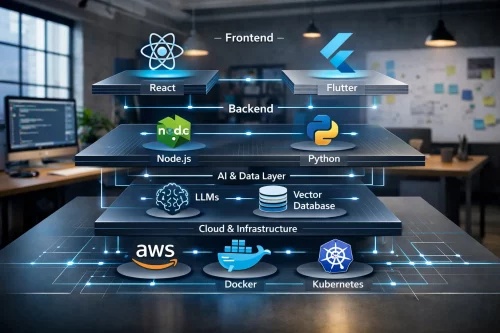
Building OXZEP7 requires a modern, scalable tech stack that supports AI-driven logic, real-time interaction and smooth cross-device performance.
Frontend and Mobile Frameworks
For web and mobile interfaces, modern reactive frameworks ensure a responsive and dynamic user experience.
Recommended tools include:
- React.js or Next.js for the frontend application architecture
- Tailwind CSS or Material UI for quick design iteration
- React Native or Flutter for cross-platform mobile apps
These technologies allow consistent design patterns and code reusability across platforms, speeding up development cycles.
Backend and API Integration
The backend must handle user state, data sync, task logic and security efficiently.
A solid backend stack would comprise:
- Node.js or Python (FastAPI) for core application logic
- GraphQL or REST API frameworks for client-server communication
- PostgreSQL for structured data such as tasks, projects and users
- Redis for handling real-time events and session caching
This combination supports scalable and structured data operations alongside real-time responsiveness for automation triggers.
AI And Automation Infrastructure
OXZEP7 should use an AI architecture that can evolve without tying the entire application to one model or provider.
A practical architecture can include:
- LLM APIs behind an abstraction layer so models can be changed when requirements evolve
- Retrieval from authorised company data when responses require internal context
- Embeddings and vector search only where semantic retrieval provides a clear benefit
- Deterministic rules for workflows that should not depend on generative AI decisions
- Queues or workflow engines for long-running and asynchronous automation
- Evaluation datasets for checking AI accuracy before and after model changes
- Permission controls for every external tool or data source accessible to the assistant
A dedicated vector database such as Pinecone or Weaviate is therefore an option rather than a universal requirement. Some projects may use existing database infrastructure with vector-search capabilities instead.
Hosting, Scaling And Deployment
The deployment architecture should match actual traffic, availability and operational requirements rather than assuming every OXZEP7 implementation needs Kubernetes from the beginning.
Suitable components may include:
- Docker for consistent application packaging where containers are appropriate
- Managed cloud platforms, serverless services or container services for early-stage deployments
- Kubernetes when workload scale, service complexity or operational requirements justify container orchestration
- Automated CI/CD pipelines for testing and controlled releases
- Secure secrets and configuration management
- Automated database backups and recovery procedures
- Centralised logs, metrics and distributed tracing for production monitoring
Observability should be designed into the application rather than added only after performance problems occur. Monitoring application requests, AI operations, workflow failures and infrastructure behaviour makes problems easier to diagnose as usage grows.
What Is the Step-by-Step Roadmap to Build OXZEP7?
OXZEP7 development should move through validated stages rather than attempting to build every AI, automation and collaboration feature at once. Development time will depend on integrations, security requirements, team size and the complexity of the AI functionality.
Phase 1 – Requirements And MVP
Start by validating the problem and building only the features required to demonstrate the platform’s core value.
Initial work should include:
- Documenting functional and non-functional requirements
- Designing the core task and user data model
- Building basic authentication and permissions
- Creating the main task-management workflow
- Adding a limited AI planning or summarisation capability
- Testing the MVP with representative users
The objective is to establish whether users actually benefit from the proposed workflow before more expensive automation is introduced.
Phase 2 – Integrations, Testing And Safe Automation
Once the core workflow is stable, development can expand into connected productivity features.
This stage can include:
- Calendar, email, CRM and communication integrations
- Workflow automation and notification rules
- Team workspaces and permissions
- Unit, integration and end-to-end testing
- AI response and workflow evaluation
- Security testing and vulnerability management
- Human approval for higher-impact automated actions
Staged releases can expose new capabilities to smaller groups before organisation-wide deployment.
Phase 3 – Scale, Governance And Enterprise Readiness
The final stage should concentrate on reliability and governance rather than simply adding more features.
Priorities can include:
- Scalable infrastructure and performance optimisation
- Centralised monitoring and alerting
- SSO and advanced role-based access
- Detailed audit logging
- Data-retention and deletion controls
- AI model and prompt evaluation
- Disaster recovery and backup testing
- Public or partner APIs where required
The platform should continue to evolve after launch using production metrics, user feedback and regular security reviews.
How Should OXZEP7 Development Costs And Monetisation Be Planned?
OXZEP7 costs should be considered across the complete software lifecycle rather than only the initial development stage. AI-heavy productivity applications can generate continuing expenses through model usage, data processing, integrations, monitoring and support.
| Cost Area | What To Consider |
| Application Development | Frontend, backend, mobile interfaces and UX |
| AI Services | Model requests, embeddings, retrieval and evaluation |
| Integrations | Calendar, email, CRM and third-party APIs |
| Infrastructure | Databases, storage, compute, queues and backups |
| Security | Access control, SSO, testing, audit logs and monitoring |
| Operations | Support, maintenance, observability and future development |
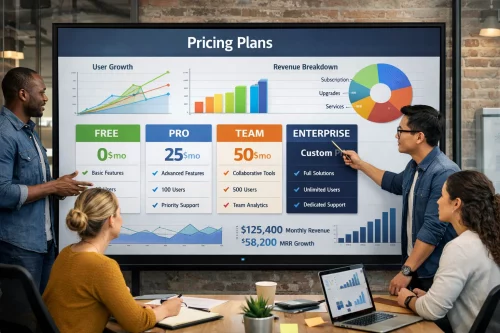
A commercial product can still use Free, Pro, Team and Enterprise tiers, but features should be based on validated customer demand rather than an assumed pricing structure.
For AI-intensive functionality, a hybrid model may be more sustainable. Core collaboration features can be priced per user while unusually high AI or automation usage can be controlled through allowances or usage limits.
Enterprise plans may justify higher pricing where they include SSO, advanced security controls, audit logs, administrative policies, service commitments and specialised integrations.
Conclusion
Developing OXZEP7 software is best approached as the creation of a custom intelligent productivity platform rather than the implementation of a verified, standardised OXZEP7 framework.
The strongest development strategy starts with clear requirements, uses AI only where it creates measurable value and combines automation with appropriate permissions, testing and human oversight.
Infrastructure should then scale with genuine operational demand instead of introducing unnecessary complexity from the beginning.
With maintainable architecture, secure development practices, continuous evaluation and reliable monitoring, an OXZEP7-style platform can evolve from a focused MVP into a broader productivity and workflow system.
FAQs About Developing OXZEP7 Software
Is OXZEP7 A Real Public Software Framework?
As of August 2026, there is no widely recognised public OXZEP7 framework, package or official technical specification that developers can rely on. It is safer to treat the name as a custom software concept unless verified documentation is available.
Which Programming Language Should Be Used For OXZEP7?
There is no mandatory OXZEP7 programming language. Python, TypeScript, JavaScript or other established technologies can be selected according to the application’s requirements and development team’s expertise.
Does OXZEP7 Need A Vector Database?
Not necessarily. Vector search is useful when AI needs semantic retrieval across documents or workspace data, but a dedicated vector database should only be added when the use case requires it.
Does OXZEP7 Require Kubernetes?
No. Managed cloud services or simpler container deployments may be sufficient initially, while Kubernetes becomes relevant when scale and operational complexity justify it.
How Long Does It Take To Develop OXZEP7 Software?
There is no standard development timeframe. The schedule depends on the MVP scope, integrations, AI features, security requirements, testing and the experience of the development team.
How Should An OXZEP7 AI Assistant Be Secured?
Use least-privilege access, controlled integrations, secure data handling, regular AI evaluations and human approval before high-impact automated actions.
Can OXZEP7 Integrate With Third-Party Applications?
Yes, a custom OXZEP7-style platform can connect with calendars, email systems, CRMs and other productivity tools through supported APIs, webhooks and authorised integrations.