






















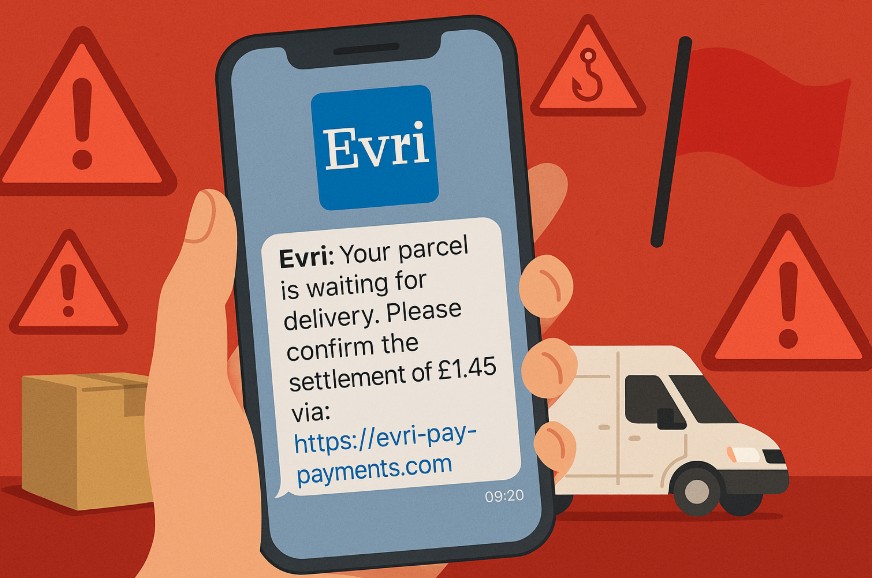
Fake Evri delivery texts remain a common phishing tactic in the UK, with criminals impersonating the parcel company to steal personal information, passwords and payment details. These messages often claim that a delivery has failed, an address needs updating or a small redelivery fee must be paid.
Evri warns that genuine SMS messages will not come from an ordinary mobile number, will never ask for payment or tell customers to install an app, and will only include a tracking link.
If a message is unexpected, customers should avoid using its links and check the parcel directly through Evri’s official website or app.
Last Updated: 22 August 2026
What Is the Evri Tracking Scam?
The Evri tracking scam is a phishing technique where fraudsters impersonate Evri (formerly Hermes) to deceive individuals into clicking malicious links or providing sensitive personal details.
These scam attempts typically arrive in the form of text messages or emails and are made to appear as legitimate delivery updates.
Scammers design these messages to look official, using Evri’s logo, brand colours, and structured formatting. They often contain a sense of urgency, such as suggesting a missed delivery, a pending fee, or an issue requiring immediate attention.
The most common methods used in these scams include:
- Sending fake texts about parcel delivery issues
- Requesting small fees to release or redeliver a package
- Providing links to spoofed websites that imitate Evri’s legitimate pages
- Collecting card details, addresses, and login credentials under false pretences
Once a user clicks the link, they are typically taken to a fraudulent website. There, the scam either attempts to steal credentials or initiates a fake payment process. These fake pages often look convincing, especially to someone expecting a real parcel.
How Can You Identify a Fake Evri Delivery Text?
Spotting the difference between a legitimate and fake Evri message can be challenging, but there are tell-tale signs that can help.
These scam texts usually contain poor spelling, suspicious links, and generic messages. Recognising these red flags can prevent becoming a victim.
Look out for:
- Misspelt words or unnatural phrasing, such as “your parcele has returned”
- Links that don’t begin with evri.com or contain unusual characters
- Messages addressed vaguely with “Dear Customer” rather than by name
- Payment requests for minor fees which Evri would not normally charge via SMS
- Unusual sender details, such as mobile numbers or personal email addresses
Why Are Delivery Scams Like This Becoming More Common in the UK?
Delivery scams have risen in the UK due to a cultural and economic shift toward online shopping.
Consumers are receiving more parcels than ever before, making them susceptible to messages that claim there’s an issue with a delivery.
Fraudsters take advantage of this frequency, knowing that recipients are likely to believe a message referencing a parcel.
Several contributing factors include:
- A massive increase in e-commerce activity since 2020
- Consumer reliance on courier updates from various services
- Inconsistent naming conventions across delivery platforms
- The difficulty of tracking every parcel or remembering every retailer used
Delivery scams remain effective because millions of consumers regularly receive parcel notifications, making an unexpected delivery message appear plausible. Criminals can also use information available online to personalise phishing attempts and make messages more convincing.
Scam messages are becoming harder to identify from spelling and grammar alone. Report Fraud warns that advances such as artificial intelligence can make fraudulent messages increasingly convincing, so unexpected payment requests, suspicious links and pressure to act quickly are more reliable warning signs.
The Evri brand is commonly targeted due to its recognisability and the high volume of parcels handled across the UK.
What Should You Do If You Receive a Suspicious Evri Text?
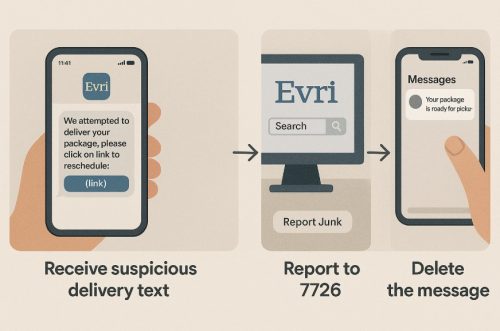
Receiving a suspicious message claiming to be from Evri can be unsettling, especially if you’re genuinely expecting a parcel.
Scammers often rely on this exact timing to increase their chances of success. However, taking the right steps immediately can prevent you from falling victim to fraud.
The most important action is to stay calm and avoid engaging with the message until you’ve verified its legitimacy.
Reacting too quickly, such as clicking a link or responding, can expose your personal or financial information.
Here’s a step-by-step guide on what to do:
1. Don’t Click on Any Links
One of the most common tactics used in Evri tracking scams is to embed a malicious link in the message. These links may lead to:
- Fake Evri websites designed to steal personal details
- Phishing pages asking for login credentials or payment
- Pages that attempt to install malware or tracking cookies on your device
Never click the link, even if it appears to look legitimate. Scammers often use techniques like “URL masking” to make it seem like the link leads to evri.com when it doesn’t.
2. Do Not Respond to the Message
Replying to the text, even just to say “stop” or “unsubscribe,” can confirm to scammers that your number is active. This could lead to more scam attempts or your number being sold to other fraud networks.
Silence is the best policy. Delete the message after taking the necessary steps to report it.
3. Screenshot the Message
Before deleting the message, take a screenshot. This could be helpful if you need to report the scam to:
- Your mobile provider
- Action Fraud
- Evri’s customer service
- Legal or cybercrime investigators
Make sure the screenshot clearly shows the sender’s number and the full message content.
4. Verify the Message Independently
If you’re concerned that the message might be real, especially if you’re waiting for a delivery, visit Evri’s official website directly. Do not use any links from the suspicious message.
Instead, type www.evri.com into your browser or use the Evri mobile app. Enter your parcel tracking number manually, or contact their customer service team to check whether any delivery issues exist.
You can also check the sender information:
- Check The SMS Sender: Genuine Evri SMS messages should appear as coming from “Evri”, rather than an ordinary mobile phone number
- Never Pay Through A Delivery Text: Evri says its SMS messages will never request payment or ask you to pay to reschedule a delivery
- Be Careful With Links: Genuine SMS messages only use tracking links, but customers who are unsure should open Evri’s website or app independently instead of using the message
- Check Email Domains Carefully: Evri uses several legitimate email domains, including @evri.com, @hermes-europe.co.uk and @myhermes.co.uk, as well as some additional domains listed on its cybersecurity page
5. Forward the Message to 7726
In the UK, the number 7726 is a free spam-reporting service offered by most mobile networks, including EE, O2, Vodafone and Three. By forwarding scam texts to 7726, your provider can investigate and potentially block the sender.
To do this:
- Open the suspicious message
- Tap “Forward” and send it to 7726
- You may receive a follow-up asking for the sender’s number reply to that with the number or sender ID
This quick step helps network providers clamp down on widespread scams.
6. Report The Scam To Report Fraud, NCSC And Your Mobile Provider
UK fraud reporting changed on 4 December 2025, when Report Fraud replaced Action Fraud in England, Wales and Northern Ireland. People in Scotland should continue reporting fraud and cybercrime to Police Scotland on 101.
If you receive a suspicious Evri message:
- Scam Text: Forward it free to 7726, which allows your mobile provider to investigate the sender
- Suspicious Email: Forward it to report@phishing.gov.uk
- Evri Impersonation: Report suspicious Evri emails or texts through Evri’s official fraud-reporting channels
- Money Lost Or Details Compromised: Report the incident to Report Fraud if you are in England, Wales or Northern Ireland
- Scotland: Contact Police Scotland on 101 for fraud and cybercrime reports
Report Fraud also accepts reports about suspicious messages, websites, social media activity and phone calls.
7. Delete the Message from Your Device
Once the message has been documented and reported, it’s best to delete it. Keeping scam messages in your inbox increases the chance of accidental clicks, especially if you’re distracted or sharing your device.
Deleting also helps ensure that others using your phone such as children or elderly family members, aren’t tricked into engaging with the message.
8. Monitor for Follow-Up Scams
In some cases, scammers may send additional follow-up messages or try to reach you via another method, such as email. If you’ve interacted with the original message at all, be extra cautious about:
- Emails or calls from unknown contacts
- New scam attempts referencing your name or parcel details
- Messages demanding urgent payment or verification
It may also be helpful to check if your personal data has been leaked using services like Have I Been Pwned, particularly if you suspect your information has already been compromised.
How Can You Protect Yourself From Future Parcel Delivery Scams?
Protection starts with digital hygiene and being cautious when dealing with unexpected communications.
Avoiding scam messages entirely isn’t always possible, but reducing risk and recognising fraud early makes a big difference.
Effective ways to stay protected:
- Activate spam filters and anti-phishing protection on your mobile and email accounts
- Install security software that blocks access to fake or high-risk websites
- Use strong passwords and never reuse the same password across multiple platforms
- Enable two-factor authentication (2FA) on email, banking, and delivery accounts
- Keep software and apps up to date to patch known vulnerabilities
- Regularly monitor financial accounts for any unauthorised activity
Many banks and antivirus providers now offer real-time scam alerts and website verification tools. Taking advantage of these services can enhance protection considerably.
Are There Any Real Examples of the Evri Tracking Scam?
Yes, various examples have been shared by victims and consumer protection agencies. These scam messages often mimic genuine updates and create false urgency to trick the recipient.
Examples include:
- “We tried to deliver your package today but missed you. Please reschedule at [fake-link].”
- “Your parcel from Evri is on hold due to unpaid customs charges. Pay now: [spoofed-URL].”
- “Action Required: Your delivery will be returned unless rescheduled here: [malicious-link].”
These scams are often timed around holidays or high delivery periods like Black Friday, Christmas, and back-to-school seasons.
Scam emails may also use similar wording or formats, making it essential to verify every communication, especially if you weren’t expecting a delivery.
What Are the Consequences If You Fall for an Evri Scam?
Falling for an Evri scam can lead to both immediate and long-term consequences. These may include financial loss, stolen identity, or exposure to further fraud attempts.
Many scammers sell compromised personal information to other fraud networks, increasing the risk of repeated targeting.
Consequences can include:
- Financial fraud: Unauthorised charges or drained bank accounts
- Account takeover: Loss of access to email, shopping, or financial services
- Identity theft: Use of your personal details for credit applications or online fraud
- Emotional distress: Anxiety or embarrassment related to falling victim
If you entered information or made a payment through a fake Evri website, act quickly:
- Contact Your Bank Immediately: Tell your bank or card provider if payment or banking details were shared
- Change Compromised Passwords: Change the affected password and any other accounts where the same password was reused
- Check Your Device: Run an antivirus or security scan if you downloaded anything or believe the device may have been compromised
- Monitor Your Accounts: Check bank, card and online accounts for transactions or activity you do not recognise
- Report The Fraud: Use Report Fraud in England, Wales or Northern Ireland, or Police Scotland on 101 in Scotland
- Report The Phishing Message: Forward suspicious texts to 7726 and suspicious emails to report@phishing.gov.uk
The NCSC specifically advises people who have entered banking or card information on a phishing site to contact their bank immediately.
Recovering from identity theft or fraud can take time. Acting swiftly minimises the damage and helps with potential compensation or reimbursement.
Can Evri or Other Delivery Companies Prevent These Scams?
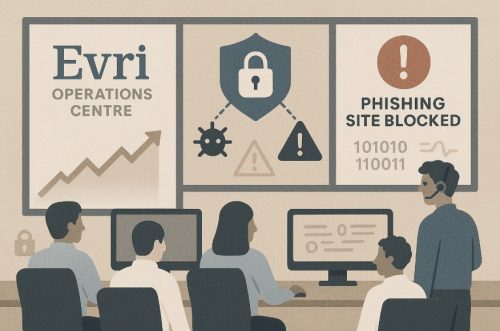
While Evri and other logistics companies invest in scam prevention measures, including domain monitoring and customer alerts, it is not always possible to eliminate every fraudulent site or message. Cybercriminals frequently shift strategies and use sophisticated tactics to evade detection.
Evri has publicly acknowledged the challenges and responded by:
- Publishing educational guides about scam detection
- Reporting and taking down thousands of spoofed websites
- Encouraging consumers to only use their official channels
- Providing examples of scam messages to raise awareness
That said, consumer caution is still the most reliable safeguard. Remaining sceptical of unsolicited communications and verifying details independently remains key in stopping scams before they start.
Conclusion
Evri phishing scams continue to exploit the fact that people regularly receive genuine parcel updates, making fake missed-delivery and redelivery messages easier to believe.
The safest approach is to avoid unexpected links and payment requests and verify a parcel independently through Evri’s official website or app.
Genuine Evri texts should not request payment or come from an ordinary mobile number. Suspicious texts can be forwarded to 7726, while people who lose money or suffer fraud should contact their bank immediately and report the incident through Report Fraud in England, Wales and Northern Ireland or Police Scotland in Scotland