


























There is no reliable evidence confirming that one billion people will become digital nomads by 2035. The figure came from a 2015 prediction based on expected growth in freelancing, remote work, internet connectivity and global mobility.
However, digital nomadism has grown substantially. The latest available MBO Partners research counted 18.5 million digital nomads in the US in 2025, representing approximately 12% of the American workforce.
The movement is therefore clearly growing, but whether it reaches one billion people globally by 2035 remains uncertain.
Last Updated: 26.06.2026
What Is a Digital Nomad?
A digital nomad is someone whose work can be performed remotely using digital technology and who uses that flexibility to work while travelling or living temporarily in different locations.
Digital nomads can include:
- Freelancers Working with clients from different locations
- Remote Employees Working for a company while travelling
- Consultants Providing specialist services online
- Entrepreneurs Managing internet-based businesses remotely
- Content Creators Producing and monetising digital content
- Developers And Designers Delivering technology or creative projects online
Being a digital nomad does not necessarily mean constantly travelling between countries. Some nomads remain in one destination for several months, while others move between cities within their own country.
This distinction has become increasingly important as the digital nomad lifestyle matures.
Why Is Digital Nomadism Growing in 2026?
Several developments have made location-independent working far more practical than it was a decade ago.
Cloud storage, project management software, video conferencing, online payment systems and collaboration platforms allow many jobs to be completed without being physically present in an office.
Artificial intelligence is adding another layer to this shift. According to the latest MBO digital nomad research, 89% of surveyed US digital nomads reported using AI in their work, while 85% said their work depended on digital connections and technology.
Digital nomadism is also becoming less dependent on traditional freelancing.
In 2025, the number of US digital nomads with traditional jobs rose by 10%, from 10.2 million to 11.2 million. This happened despite many businesses introducing stricter return-to-office policies.
One emerging response is sometimes described as tethered nomadism. Workers still travel but remain sufficiently close to their employer’s office to return when required.
Younger generations are another major growth driver. Gen Z has entered the workforce with strong familiarity with digital technology and greater interest in flexible ways of working.
How Many Digital Nomads Are There in 2026?
 There is currently no authoritative worldwide count of digital nomads.
Different studies use different definitions. Some count only international travellers, while others include people who work remotely while travelling within their own country. This makes claims about a precise global population difficult to verify.
The strongest regularly updated data comes from the United States.
MBO Partners recorded:
| Year | US Digital Nomads |
| 2023 | Around 17.3 Million |
| 2024 | 18.1 Million |
| 2025 | 18.5 Million |
The 2025 figure represents a 153% increase compared with 2019 and approximately 12% of the US workforce.
The demographic profile is also changing.
In 2025:
- Millennials Accounted for 40% of US digital nomads
- Gen Z Accounted for 35%
- Gen X Accounted for 19%
- Baby Boomers Accounted for 6%
Together, Millennials and Gen Z represented 75% of the digital nomad population studied. More than half, 54%, were married or living with a partner, while around 11% were aged 55 or older.
Digital nomadism therefore cannot simply be described as a lifestyle for single people in their twenties.
Most Popular Digital Nomad Destinations in 2026
The best destination for a digital nomad depends on much more than cheap accommodation.
Important factors now include:
- Living Costs Whether everyday expenses fit the worker’s income
- Internet Quality Reliable connections for meetings and online work
- Visa Rules Whether remote work is permitted under the country’s immigration system
- Tax Requirements Whether staying or working there creates tax obligations
- Accommodation Availability of suitable medium-term housing
- Safety Personal security and political stability
- Community Access to coworking spaces and other remote professionals
- Time Zones Compatibility with employers and clients
Countries including Portugal, Spain and Thailand have attracted significant interest from location-independent workers.
Thailand, for example, introduced the Destination Thailand Visa for eligible digital nomads, remote workers and freelancers.
Official Destination Thailand Visa requirements state that the visa is valid for five years with multiple entries and allows a stay of up to 180 days per entry.
This illustrates an important change from the early days of digital nomadism. Workers can no longer simply look for the cheapest destination and assume they can legally work there.
Visa conditions, tax residence, employment regulations and length-of-stay rules need to be considered before relocating.
Another emerging trend is slomading, where digital nomads stay longer in fewer destinations.
In 2025, digital nomads surveyed by MBO Partners visited an average of 6.2 locations, down from 7.2 in 2023. At the same time, the average stay increased from 5.4 weeks in 2023 to 6.4 weeks in 2025.
Longer stays can reduce travel fatigue while giving workers more time to establish routines and experience local communities.
What Jobs Do Digital Nomads Do?
Digital nomad careers are concentrated in jobs where output can be delivered digitally.
Current research identifies major fields including:
- Information Technology Software development, cybersecurity and technical support
- Creative Services Graphic design, photography, video and content creation
- Marketing SEO, digital advertising, social media and communications
- Sales Online business development and account management
- Finance And Accounting Bookkeeping, analysis and financial services
- Consulting Business, technology and specialist advisory work
- Research And Development Digital research and knowledge-based projects
AI is becoming particularly significant.
In the latest available study, 89% of digital nomads said they used AI at work, while 88% described their AI ability as either intermediate or advanced.
Nearly half, 49%, also reported earning money through the creator economy.
This does not mean every profession can become location-independent. Healthcare, manufacturing, construction, retail and many service jobs still require substantial physical presence.
The strongest digital nomad opportunities remain in industries where work can be completed, reviewed and delivered through the internet.
Digital Nomads vs Remote Workers
Digital nomads and remote workers are related, but they are not necessarily the same.
| Factor | Digital Nomad | Remote Worker |
| Primary Work Method | Remote | Remote |
| Location | Changes periodically | May remain permanently at home |
| Travel | Central to lifestyle | Optional |
| International Work | Common but not required | Less common |
| Visa Considerations | Frequently important | Usually limited |
| Tax Complexity | Can involve several jurisdictions | Often simpler |
| Employer Permission | May be required | Usually defined by company policy |
Someone working from their Manchester home for a London company is a remote worker, but they would not normally be considered a digital nomad.
If that same employee spends several months working from Portugal, Thailand and Spain, the arrangement starts to fit the digital nomad model.
The distinction matters for employers too. Working from another country can potentially affect immigration permission, employment law, payroll, tax and data-security responsibilities.
For UK workers in particular, residence status can affect how foreign income is taxed, so travelling abroad does not automatically remove UK tax responsibilities.
Benefits and Challenges of Being a Digital Nomad
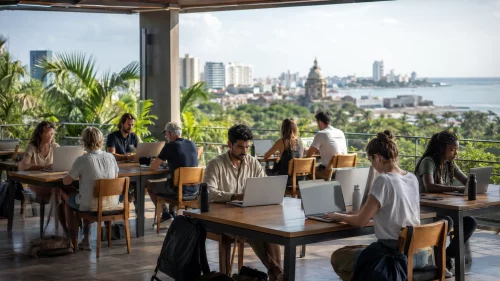 The digital nomad lifestyle attracts workers because it offers something conventional office employment often cannot provide: geographic choice.
Potential benefits include greater freedom over where to live, opportunities to experience different cultures and the ability to combine work with travel.
Work satisfaction among digital nomads is high. In the 2025 MBO research, 82% reported being highly satisfied with their work, while another 12% described themselves as satisfied.
However, digital nomadism also involves practical challenges.
Common difficulties can include:
- Loneliness Being away from friends and family
- Travel Fatigue Regularly changing accommodation and transport
- Internet Problems Unreliable connectivity disrupting work
- Time Differences Working unusual hours for overseas clients
- Income Uncertainty Particularly for freelancers
- Tax Complexity Potential obligations across different jurisdictions
- Visa Restrictions Limits on how long someone can remain or work
- Housing Costs Rising short-term accommodation prices
- Cybersecurity Risks Working across public or unfamiliar networks
This is one reason the movement towards slower travel is important. Staying in one destination for longer can provide more stability while preserving geographic flexibility.
Digital Nomad Trends: 2023 vs 2026
Digital nomadism has changed noticeably since this article was first published in 2023.
| Area | 2023 | 2026 Position |
| Digital Nomad Numbers | Rapid post-pandemic growth | Growth continues at a slower pace |
| Main Worker Type | Strong freelancer association | More traditional employees involved |
| AI Usage | Emerging productivity tool | Used extensively by digital nomads |
| Travel Pattern | Frequent destination changes | Longer stays gaining popularity |
| Visa Options | Growing rapidly | Dedicated remote-work routes more established |
| Employer Policies | Often informal | Greater focus on compliance |
| Key Generations | Millennials dominant | Gen Z rapidly increasing |
| Work Model | Fully mobile lifestyle | Tethered and slower nomadism growing |
The movement has therefore become more structured.
Digital nomadism in 2026 is less about simply carrying a laptop around the world and more about managing a sustainable remote career while complying with immigration, employment and tax requirements.
Will There Really Be 1 Billion Digital Nomads by 2035?
The claim that there will be one billion digital nomads by 2035 can be traced back to entrepreneur and Nomad List founder Pieter Levels.
In 2015, Levels used trends involving population growth, freelancing, internet connectivity and remote working to estimate what the digital workforce could look like two decades later.
Importantly, he described the calculation behind the original 2035 digital nomad forecast as a “guesstimate” based on extrapolating existing trends.
His calculation assumed a world population of roughly nine billion, a labour force of around six billion, approximately half of workers becoming freelancers and about one-third of them becoming remote workers or digital nomads. That produced the one-billion figure.
A lot has changed since that prediction.
Remote work expanded much faster than expected during the COVID-19 pandemic, while cloud technology, video meetings and AI have made distributed work considerably easier.
But other forces work in the opposite direction.
Employers have introduced return-to-office requirements, geopolitical tensions affect mobility, housing has become more expensive in some nomad destinations and countries continue to enforce their own immigration and taxation rules.
There is therefore no strong statistical basis for saying with certainty that one billion people will be digital nomads by 2035.
The prediction is better understood as a vision of how large location-independent work could eventually become rather than a confirmed demographic forecast.
Conclusion
Digital nomadism has moved from the fringes of the workforce towards the mainstream.
The latest available research shows 18.5 million digital nomads in the United States alone, with Millennials and Gen Z dominating the population and traditional employees becoming an increasingly important part of the movement. AI, cloud technology and specialised visa programmes are making location-independent careers easier to sustain.
At the same time, the lifestyle is becoming more mature. Digital nomads are staying longer in fewer destinations, employers are paying greater attention to compliance and workers are considering taxation, immigration and cybersecurity alongside internet speed and living costs.
Whether the world reaches one billion digital nomads by 2035 remains impossible to know. What is much clearer in 2026 is that digital nomadism is no longer simply a temporary remote-work trend.
It has become an established way for millions of people to combine their careers with greater geographic freedom.
Frequently Asked Questions
What Is a Digital Nomad?
A digital nomad is someone who uses digital technology to work remotely while travelling or periodically living in different locations.
How Many Digital Nomads Are There in 2026?
There is no authoritative worldwide count. The latest MBO Partners study identified 18.5 million digital nomads in the US in 2025, approximately 12% of the US workforce.
Will There Be 1 Billion Digital Nomads by 2035?
Possibly, but there is no official forecast confirming it. The one-billion figure originated as a 2015 extrapolation of remote-work, freelancing and demographic trends.
What Are the Best Jobs for Digital Nomads?
IT, marketing, creative services, consulting, sales, finance, research and online content creation are among the most suitable fields because much of the work can be delivered digitally.
Which Countries Are Popular With Digital Nomads?
Portugal, Spain and Thailand are among countries frequently associated with remote workers. The best option depends on visa eligibility, living costs, taxation, internet access and permitted length of stay.
Are Digital Nomads Mostly Young People?
Younger generations dominate, with Gen Z and Millennials accounting for 75% of US digital nomads in the 2025 research. However, older workers are also represented.
Are Digital Nomads and Remote Workers the Same?
No. All digital nomads generally work remotely, but not all remote workers are digital nomads. A remote worker may stay permanently at home, while a digital nomad combines remote work with geographic mobility.